Showing posts with label self-publishing. Show all posts

Tuesday, May 26, 2015

Five Tips for Success as a Self-Published Author (and giveaway!) by Susan Kaye Quinn


Five Tips for Success as a Self-Published Author
by Susan Kaye Quinn

Can you spot the self-published titles?

Hint: they all are.

(Caveat: A.G. Riddle started out indie but is now published through Amazon's 47North imprint along with Marko Kloos)

The truth is that self-published titles now regularly top the charts - if not outright dominate them. Successful self-published titles have great covers and lots of fervent fans - often the only way to distinguish them from traditionally published titles is the publisher listing in the description (and the price - indie titles are usually less than $5.99 for single titles).

How do you become one of these successful indie authors? Hard work, luck, and educating yourself about how the indie marketplace works.

Here are FIVE TIPS to get you started. For a full run-down on how to launch your indie author career, see my Indie Author Survival Guide (Second Edition now available). To take your indie author career to the next level, pre-order my For Love or Money: Crafting an Indie Author Career (releases 7.14).

TIP #1: Study the Bestsellers - In both craft and business, studying successful people will help you discern the ingredients of success. Always be striving to take your craft up a level - by craft I mean storytelling, not just the way you string words together. Because as much as we like to disparage that poorly written erotica book at the top of the charts, I guarantee that good stories well told actually do sell. (Alternatively, if you want to chase the latest trend, that's possible now  - there's no sin in giving readers more of what they want, but it's nowhere near as easy as you think.) As far as business, look who is selling in your genre and what they did to get there. Don't follow what people say - look at what they actually do. The actions of successful people often fly in the face of conventional wisdom. (I welcome you to look at my own path to success as well as many other indie authors - often the most successful are not the ones offering advice about it! #yesIseetheirony )

TIP #2: Be a Professional - Don't dabble. Don't dip your toe into indie publishing with a short story that's not going to sell. Go full cannon-ball jump into the pond with professional covers, formatting, editing, the works. Make sure your novel can comfortably sit in the top 100 of your category. This will require up-front investment, but most books can be well-published for under $1000 - and I know of no other legit business you can start for that little money invested. Don't skimp. (Note: on the other hand, don't throw money away on a $3000 cover that will be hard to recoup; be sensible.)

TIP #3: Launch With a Series - You don't have to pre-write an entire trilogy and release the books one month apart... but that's an option now, with indie publishing. If you can write a novel in six months, you could publish the first book, then write and publish Books 2 and 3 within a year. I've seen both models be successful (note: don't wait more than six months between books). Make the commitment to quickly build a backlist and get books into readers' hands. Delivering three connected novels to readers within a year is a strong way to launch a career (note: I'm talking novels here, not novellas or short stories or serials - those are fun, but not career-launchers).

TIP #4: Launch in Amazon then Go Wide -  There's a lot to learn in indie publishing, so staying focused can be key to staying on track - plus launching a new series in the Kindle Unlimited system gives new authors/new series a boost in visibility. Use this to get your footing. Then, when you've established your brand as an author, you can expand to the other retailers (Nook, Kobo, iTunes, Google Play). You'll be a veteran at that point and in a good position to weigh the pros and cons of exclusivity vs. reach.

TIP #5: Never Stop Writing - the single most important thing you can do in your career is write the next book. Generating new IP (Intellectual Property) is the one thing only you can do - the rest can be outsourced. It's tempting to get bogged down in all the latest and greatest changes in the industry, but the biggest lever you can pull to move sales is to launch a new book. Or an entirely new series. You want to study the bestsellers, but always remember: your biggest asset is your uniqueness. Make sure you're continually feeding your creativity, reaching for that next level with your work, bringing out the fullest expression of your abilities. Spend the bulk of your time doing creative work - reading, writing, watching movies, taking workshops, using craft books to boost your skills, exploring new forms, learning how to write faster... whatever works for you to elevate your craft and increase your enjoyment of writing. This is the creative life you want, yes?

I really should have started with TIP #0: Decide What Mountain You Want To Climb - I have an entire section in my Indie Author Survival Guide about making a Mission Statement so that you know you're climbing the right hill before you set off in dogged pursuit of the success you think you want. 
Knowing what will make you happy, then having a plan to get there? That's the only key to success you actually need.

p.s. if all of this terrifies you, I understand. Truly. Watch this webinar on facing your fears and don't let that hold you back. 


Susan Kaye Quinn is the author of the Singularity Series, the Mindajck Trilogy and the Debt Collector serial (as well as other speculative fiction works) and has been indie publishing since 2011. She?s not an indie rockstar or a breakout success: she?s one of thousands of solidly midlist indie authors making a living with their works. The Indie Author Survival Guide is based on her experience in self-publishing fiction?the First Edition was published in 2013, the Second Edition in 2015, updated to account for changes in the industry. It?s a guide to help her fellow writer-friends take their own leaps into the wild (and wonderful) world of indie publishing? and not only survive, but thrive. Facebook | Tumblr | Website | All of Susan's Fiction
Indie Author Survival Guide (Second Edition) now available
For Love or Money: Crafting an Indie Author Career - preorder for 7.14

Friday, May 8, 2015

Tips for Editing Your Manuscript from a Real-Life Editor, Part 11

Welcome back to our (ir)regularly scheduled programming! 

As always, the links to the other parts in this series are at the bottom of the page.

This is Part 11: Sit on it.

No, I don't mean that in a weird rude way. 

We, as authors/writers/whatever you want to call yourself, are generally too close to our own writing to get any perspective.  You know how when you read a book (doesn't matter what kind) and can pick out errors? That's because you're a set of fresh eyes on it. 

And with our own manuscripts, there comes a time when you're literally unable to continue editing it because you're too close to the story, characters, and everything else.  At this stage, it's extremely frustrating--and bad for your manuscript--to keep going. Trust me on this. 

So, in order to get something close to a fresh set of eyes when you're the only one around to edit your manuscript, or before you send it to an editor you've hired, or what have you, you need to distance yourself from your work.  Let it sit for a while.  

The time period can vary from author to author; I prefer at least a couple of months; some authors I know let it percolate for a few weeks while they draft or outline another story. I'm aware of others who got to the point where they hated their manuscript, set it down for a year or more, and finally picked it up and edited it into something they were happy with.

I've recently started on what I feel will be my final run-through (before any kind of publication, self or otherwise begins) on my novel, Fate's Awakening. This is the first time I've really--really--looked at it as a whole in a number of months, and I'm surprised that I like what I've written. It's getting a few tweaks here and there, but nothing major (at least until it hits another editor).  See, the last time I looked at it, I hated it. I wanted to hit delete on the whole thing, and that's how I knew it was time to step back.

So, if you're done with your manuscript, schedule some time to take a break from it and sit on it for a while. Work on something else, then come back to it.  It'll do wonders.

I know this one was a shortie, but, as always, I hope it was helpful!  Let me know what your ideal "sit on it" period is in the comments. I know it's different for everyone!

xoxo Sarah


Tuesday, February 17, 2015

Tips for Editing Your Manuscript from a Real-Life Editor, Part 10

Things were getting out of hand with listing the links at the top of each post for the previous posts, so I've moved them to the bottom. Don't worry, they're still there.

When I started this, I never thought I'd reach this many posts on tips for self-editing, but here's Part 10: Editing and Writing Reference Books

This was a logical progression. After all, I use editing references when I'm editing and when I'm writing, and I thought that since there are so many out there that you guys would appreciate a look at what I use.

Is this the be-all-end-all of writing/editing guides? Hardly. I find new ones occasionally, but these are the books I keep going back to. And if you have suggestions or have a favorite one you use, I'd love to hear about it! Post in the comments to share with everyone.

Here I've picked my five favorites, and I'll nutshell them for you in terms of what I like and what I don't. Easy peasy. I haven't provided links because they're all easy to find. I'd suggest Amazon or half.com and buying used...you're likely just going to mark them up anyway with all your own notes.

Let's begin...

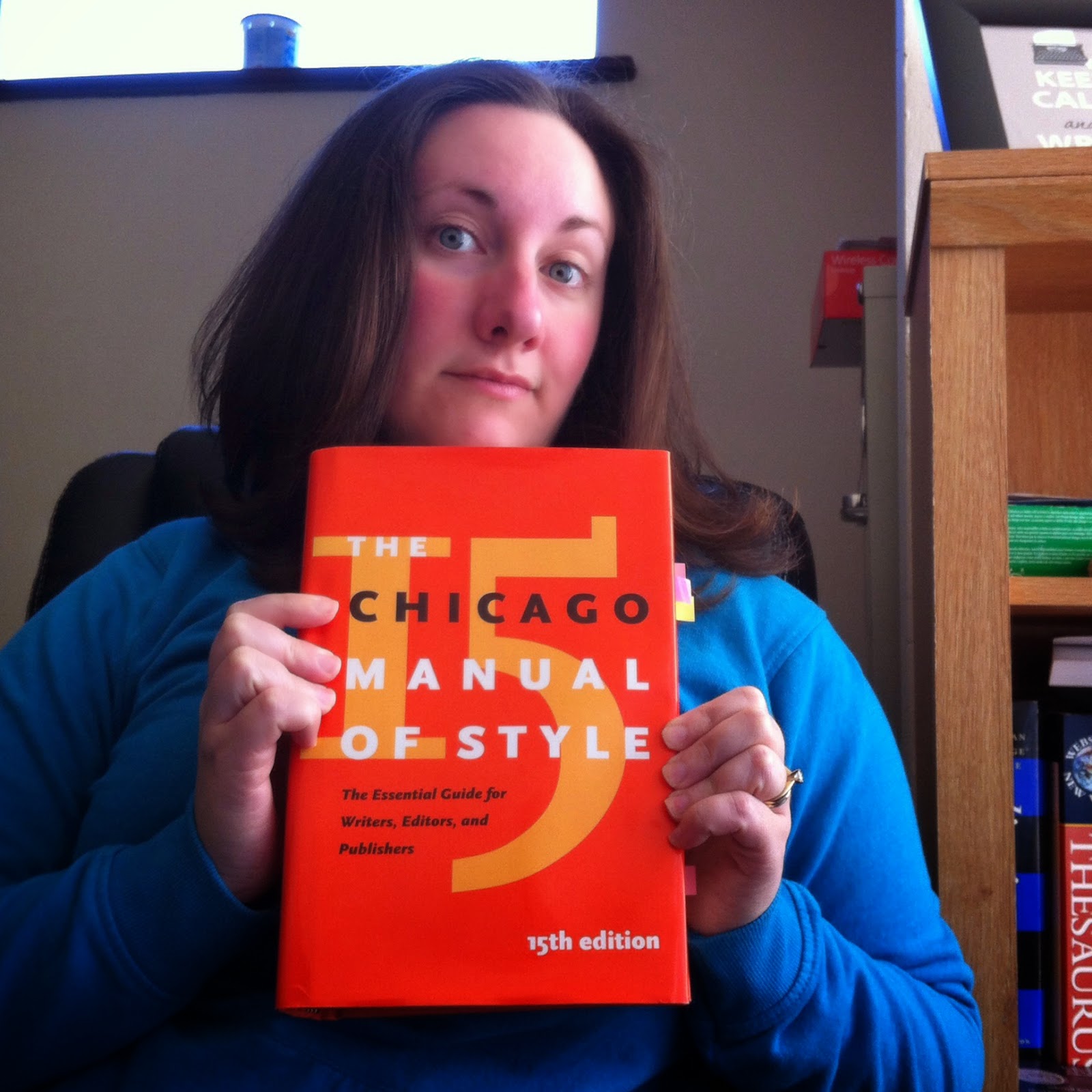
1) The Chicago Manual of Style, 15th Edition

Why do I look so "meh" in this picture? Because this book, while extremely comprehensive in terms of what it includes, extremely detailed, extremely large, and extremely useful, is also an extremely big pain in the ass.  Have I mentioned it's extreme?

If you don't know exactly where to look for the information you want, and it's not readily visible in the index at the back, finding what you want is a nightmare.  I often have to ask someone who has used it longer than I have where to find something in it--which often includes me asking them the question I was trying to find in the book in the first place because it's faster.  Then again, I have a bunch of lovely editor friends to irritate with these questions, so you may not have that luxury.  Also visible in the picture are some of the (many) sticky-note tabs I've marked pages and sections with so I don't have to go through the whole needle-in-a-haystack process again when I need the same info in the future.  If you buy this with other editing books, you'll get a lot of use out of it, though likely as a definitive answer for more obscure grammar rules.  Don't forget, I get paid to use this thing (this is the book the publisher I edit for uses as a reference), and my need for it will likely be greater than your average writer, though it might be worth a purchase anyway.

2) Painless Grammar by Rebecca Elliott, Ph.D.

I'm much more excited in this picture, and that's because this book is what most writers will need.  Most common grammar errors are addressed in easy to follow examples and situations...as the cover says, it's a "painless examination of parts of speech, sentence construction, and punctuation".  I reach for this one over the CMoS most times, though it's not quiiiiite comprehensive enough to be the only reference for someone who edits for a living, or for an author who wants to do a hardcore edit of their own work.  Again, I've sticky-note-tabbed some of my favorite breakdowns, including the explanation of "lay" and "lie" that I can never keep straight.

Plus, bonus points for the cat on the cover.


3) The Elements of Style (fourth edition) by William Strunk, Jr. and E.B. White

Yes, this E.B. White is the same guy that wrote Charlotte's Web, the book that reduced me to tears with every childhood re-read.  Thankfully, his and Strunk's writing style guide doesn't have the same reaction.

First of all, this book was recommended to me by Stephen King--sadly not personally, but through book #4 which I'll discuss in a bit.  If it was good enough for one of the most successful authors of modern times, it was good enough for me.  Strunk & White's book is short--the main part clocks in around 85 pages, not including the glossary at the end.  The breakdown includes Elementary Rules of Usage (including colons, dashes, apostrophes, etc.), Elementary Principles of Composition (including paragraphs, active voice, tenses, etc.), A Few Matters of Form, Words and Expressions Commonly Misused, An Approach to Style (including revising and rewriting, placing yourself in the background, not overwriting, over-explaining, or overstating, etc.), and the glossary at the back. There's a lot--and I mean a LOT--of direct, simple, straightforward information packed into this little book.  It's perfect for transporting, and, stacked up, about 6 or 7 will fit in my CMoS--I measured.

Again, this is the style guide Stephen King recommends, and with good reason.

4) On Writing by Stephen King

The book I'm enthusiastically pointing to is one of the best writing guides--which, oddly, isn't exactly that, nor is it a memoir or autobiography. The cover calls it "a memoir of the craft" and includes plenty of anecdotal stories by King about how he began writing in his youth, and the experiences that shaped his writing and his writing style.  But it's not all about him--he talks about what worked for him, and what doesn't or didn't, and doesn't bullshit or coddle the reader into thinking anything other than hard work and the labor of love will get you success...and maybe not even then.  I can't explain what exactly is so good about this book, but I couldn't put it down once I began reading it.  I can't recommend this book enough for any writer, no matter what genre.  Everyone will take away something different from this book.  Buy it...but finish reading this blog post first.

5) Indie Author Survival Guide by Susan Kaye Quinn

Sorry guys, no picture for this one. I have the ebook version, which I bought before it was available in paperback (which it currently is, though obviously the links within the book won't work in paper form unless you know something about books that I don't).

If you're even considering self-pubbing--maybe you're a beginning author and don't want a publisher; maybe you're a prolific author with a long back-list you've gotten the rights back to and want to self-pub; maybe you have a few traditionally published books but want to be well-rounded--whatever your reason, this book is a must-read for writers.

SKQ is a friend of mine (I guess you could call that a disclosure, though I'm certainly not receiving payment for this blog post or anything else), and she's been self-published before it was really a thing writers did. She's had a lot of time for trial and error, and has found things that have worked well for her and things that haven't, as well as things that did work but no longer do, and vice versa.  She addresses the changing face of self-pubbing and most every aspect you might, as a prospective self-publisher, have questions about.  SKQ has always been up front and eager to help writers, no matter what stage they're at, through her blog, and this book is an extremely organized (and updated) collection of her blog posts.

As I said, if self-publishing is even remotely on your radar, buy this. I've recommended it to many author-friends who have had nothing but good things to say about it.

That rounds up my favorite writing and editing guides (for now, at least)! Tell me in the comments what your favorite go-to reference is.  I'm always looking for new ones!

xoxo Sarah


Other posts in this series:

Part 1: Look it up!

Part 2:  Read it out loud.

Part 3:  Have someone who knows what they're doing read it.

Part 4:  Consistency, consistency, consistency!

Part 5:  Dialogue tag...you're NOT it!

Part 6: Pick the right word to say what you mean.

Part 7: Adverbs--Kill it with fire!

Part 8: Editors Aren't Perfect

Part 9: Frequently Seen Errors (FSEs)

Part 9.5: FSEs Pt.2

Tuesday, December 30, 2014

Tips for Editing Your Manuscript from a Real-Life Editor, Part 9.5

Part 1: Look it up!

Part 2:  Read it out loud.

Part 3:  Have someone who knows what they're doing read it.

Part 4:  Consistency, consistency, consistency!

Part 5:  Dialogue tag...you're NOT it!

Part 6: Pick the right word to say what you mean.

Part 7: Adverbs--Kill it with fire!

Part 8: Editors Aren't Perfect

I had quite a few that I thought would be helpful, so here's the second half of Part 9: FSEs (Frequently Seen Errors)


Men who sound like women

As a woman who frequently writes male perspectives, it's a (fun) challenge to get in their heads and write from their point of view. But we've collectively read so many stories where the male characters are basically women with penises. So, if you're writing a man, try very hard to see things from their perspectives. How do they think? A man who is describing a woman's clothing would notice different things than a woman would--is the dress tight, pink, and short? He's not going to notice that it's peach, chiffon, or tea-length (unless the character is a fashion designer or something). When in doubt, ask a man--brother, father, son, husband, whoever--to describe something, or how they'd say something. It'll probably be short and sweet. There are lots of great posts out there on how to write men, so hit up Google.

Over-reactions as a major plot device

People--both real ones and the ones you've created in your manuscript--make mistakes and misinterpret things. We get that, we really do, and they're okay in small doses. It helps create some mild conflict so we get to see who the characters are. But using a huge misinterpretation or something similar leading to an overreaction as a plot device is getting stale. There are soooo many movies and books that do this that it's pretty played out.  You saw your man having coffee with a woman in a Starbucks you happened to walk by?  Yep, better freak out and overreact and assume he's cheating on you rather than: 1) going in and saying hello; 2) mentioning it to him later on when you're alone; or 3) anything else a real, sensible adult would do. Common plot twist discovered later: she's his sister/lesbian best friend/happily married boss, and that overreaction was all for naught. Huh. Who woulda thought?

Play-by-plays

Collectively, we agreed that we don't need to hear about everything the characters are doing. One of the freelance editors I was speaking with mentioned a page-long (several paragraphs in Word) meal scene she read where nothing major happened, certainly nothing necessary to the plot. But there were descriptions of what the characters were eating, how they were eating, everything. There was a whole play-by-play scene that did nothing that "X, Y, and Z had pizza for dinner before going out" couldn't have done. Again, we realize you're probably looking to pad the word count, but if you find a scene like this, cut it down. Description is often good and important, and it might take practice to find these stray scenes, but do your best.

Simple punctuation errors

Why would this drive an editor crazy? Because it's so easy to look up. It's almost cliche at this point, but there's a big difference between "Let's eat Grandpa!" and "Let's eat, Grandpa!"--mostly cannibalism.  Please, for the love of Jesus on a Velociraptor, if you want any editor or publisher worth their salt to take you seriously--or, if you're self-pubbing, for the readers to not tear you a new one in your Amazon reviews over your shitty grammar skills--look up how to properly punctuate--especially around dialogue. And please...apostrophes aren't necessary to make something plural. Really. Please stop abusing them. What have they ever done to you?

Excessive name or nickname use

Think about the last conversation you had with a person or even a group of people. Now think about how many times you actually said one of their names out loud, especially if it was just you and the other person. Maybe once? If it was a group, maybe a few times--if that--to specify who you were talking to? Keep this in mind when writing dialogue scenes, as this often gets out of hand. It's easy enough to tell who's talking if you use tags like "Brian said" or "Melanie asked". If there's a group, you can probably get away with using names more often, or to specify who is talking to whom, but keep it to a minimum. Your readers will thank you for it.

As for excessive nicknames, they can actually confuse the reader, especially if you have a large cast already. The readers will likely wonder, "Who is this?" and get frustrated. If you have a character named Katherine, it's logical that some people would call her Kate. But it's probably not necessary for her to also be called K-Dawg, Special K, and Katy-Kat by other characters.

I hope this little peek into frequently seen errors has helped you out!

What do you think?

xoxo Sarah

Saturday, December 27, 2014

Tips for Editing Your Manuscript from a Real-Life Editor, Part 9

Part 1: Look it up!

Part 2:  Read it out loud.

Part 3:  Have someone who knows what they're doing read it.

Part 4:  Consistency, consistency, consistency!

Part 5:  Dialogue tag...you're NOT it!

Part 6: Pick the right word to say what you mean.

Part 7: Adverbs--Kill it with fire!

Part 8: Editors Aren't Perfect


Here's Part 9: FSEs (Frequently Seen Errors)


I was chatting with some friends in the freelance editing world recently, and the subject of common mistakes we see over and over in our various projects came up. Basically, these were frequently seen errors (I'll call them FSEs because I like to throw an acronym in now and then) that we saw in manuscripts--grammar, spelling, punctuation, plot, pacing, phrasing, you name it. We've all been doing this a while, so we notice trends.

And I thought that since this is a series on how to self-edit, it could maybe do some good in helping folks see if they're doing any of these things that drive editors crazy.  Because a lot of what we freelancers do--besides the standard grammar/spelling/punctuation-nitpicking--involves the stuff that makes a story good.  And we all know that you guys want to write good stories (that have excellent grammar/spelling/punctuation too, of course)!

Just for a little background so you know we know what we're talking about, the lovely freelance editors I spoke with and I cumulatively have 10+ years editing (of all kinds, and all genres) experience between us.

Info-dumping

This is one that came up a few times and I know I'm guilty of as a writer--when I write something, before it's edited, I generally have tons of information in clumps. I want the reader to know allthethingsimmediatelyOMG. I've shoveled it when I should have sprinkled it, and it doesn't do the story any good. Trust me. Spread it out--one of the things that keeps the readers reading is if they don't have all the information at once. Oddly, this usually happens with character back-story.

Gestures

Characters making gestures is natural--they're "people", after all. But too many gestures, or too much physicality, can take the reader right out of the story. Are your characters constantly touching each other, or rolling their eyes, or any number of other physical things/gestures, especially if dialogue is interrupted to stick those gestures in there? Get another person to read it to make sure it's not too much, especially if it distracts from the story. Another big positive: If you limit writing gestures, then it will also make the ones you do include more powerful and meaningful.

Eye stuff

This deserved it's own category. There's often so much about characters LOOKING at each other. Gazing. Staring. What have you. Let the reader fill in the blanks to picture what's going on, and stop giving the reader the impression that the characters are trying to hypnotize each other. Eye-rolling, also. Limit this to, like, almost never. Trust us. If you need to show exasperation, there are much better ways to go about it. The Emotions Thesaurus is awesome for this.

Mouth stuff

At the risk of sounding dirty, mouth stuff is another thing we kept seeing. Mouths popping open in surprise. Mouths gaping. Jaws dropping. Again, how many times does this happen to real people, and, again, there are better ways of showing surprise.

Both writing that undermines the reader's intelligence AND writing that's pretentious

Both sides of the coin can be hard to deal with as both a reader and an editor, and a happy medium must be struck. If you dumb your writing down and spoon-feed the story to the reader, they're going to be insulted.  On the other hand, if you use words you'd see on the SAT and you're writing a cook book, again, probably time to reevaluate.  Take-home message: Readers are smart, and don't write for the lowest common denominator.

"...think to myself..."

We agreed that the only appropriate use of this would be if you're writing a story involving telepathic characters--in other words, when you might actually need to clarify who the character is thinking to. Otherwise, who the heck else would they be thinking to?  "I thought" is just fine.

Adverbs

Read this: Part 7: Adverbs--Kill it with fire!  Enough said. Yes, we get that adverbs help pad your word count. Still, don't do it.

Sex scenes

Why is this on here? Because you'd be surprised the number of scenes we've read that aren't quiiiite up to par. What do we mean? Sometimes you'll run across one with a position that's not physically possible (and not even in the realm of fantasy--like, the guy would have needed to sprout a third arm or something), or that uses the word "moist".


Need some help writing erotic or sexy scenes without fading to black, no matter how tame or kinky? There are tons of guides on Amazon, so check them out.

I'll be doing a post on this soon, probably after the new year, so keep an eye out for it.

This concludes the first half...I didn't want the post to get too long. The other half should be up soon!

Are these helpful? What do you think?

xoxo Sarah


Monday, December 15, 2014

Tips for Editing Your Manuscript from a Real-Life Editor, Part 8

Part 1: Look it up!

Part 2:  Read it out loud.

Part 3:  Have someone who knows what they're doing read it.

Part 4:  Consistency, consistency, consistency!

Part 5:  Dialogue tag...you're NOT it!

Part 6: Pick the right word to say what you mean.

Part 7: Adverbs--Kill it with fire!


Welcome to Part 8: Editors Aren't Perfect.


I'm often asked whether anything trips me up as an editor. And the answer is, unequivocally, YES. There are just some things that, even after repeated hammerings-in, just don't make it into my thick scull.

I'm not afraid to admit that I don't know everything related to writing, but that's why I own copies of several different editing and/or style guides.

But what stumps me? What's bookmarked and dog-eared in my editing reference books?

I'll tell you.

Keep in mind that these are just a few things, and, for the sake of brevity, I'm not going to go into detail on the correct meanings or usage of them--feel free to look those up, though I might stick a link or two in there if I feel like it.

Lie and Lay  

For the life of me, I can't keep this one straight, especially since the different tenses of the different words are often the same or cross-overs. This has to be one of the most-visited section of my editing guides, particularly because I have to look up the proper usage each time one of these (or a tense) is used.

Affect and Effect

Ugh. This one. Every time I use one in my own writing, even a freakin' Facebook post, I have to look it up. Drives me crazy that I can't keep this straight.

Time Format

Should it be AM/PM? a.m./p.m.? am/pm? Where does it go in relation to the actual numerals? This one is a frequently visited page when it comes up, which, thankfully, isn't often.

Colons and Semi-Colons

I've been told before that I sometimes misuse semi-colons, and I'd rather not use them at all than use them incorrectly. Colons are used so infrequently (unless it's with time) that when I see one used with a list or something else, it's an automatic look-up. Personally, I'm not a fan.

Em Dashes 

Usually these don't bother me and are more of a stylistic thing I rather like using in my own work, but they sometimes trip me up when wondering where to place them in dialogue that has been interrupted by something, typically a character's action.  Though, oddly enough, it makes a difference whether the dialogue stops completely for the action to take place, or whether the dialogue continues on, and the interruption is more of a note for the reader. Complicated? Not really. Hard to keep straight? Yep.

Example showing more of a "dialogue note" interruption, straight out of my CMoS 15 that I consult regularly: "Someday he's going to hit one of those long shots, and"--his voice turned huffy--"I won't be there to see it."  Blogger is weird and won't let me use a proper em dash, but the little hyphens there are the same thing.


This obviously isn't a comprehensive list, but there you have it!

What grammar/spelling/punctuation thing leaves you stumped every time?

xoxo Sarah


Sunday, November 2, 2014

New Newsletter! Woot!

I've been taking a class on how to self-publish on a shoestring by the amazing Magda Alexander for the past month, and one thing that was discussed was having a mailing list or newsletter.  Readers can sign up to get it, so you can update them on whatever's going on--a new release, contest, etc.

So, if you want updates on my writing, publishing, contest and giveaway news, either sign up in the side-bar on the right, or click the link here and sign up.  

I'd really appreciate it!

xoxo Sarah

Thursday, October 2, 2014

Tips for Editing Your Manuscript from a Real-Life Editor, Part 7

Part 1: Look it up!

Part 2:  Read it out loud.

Part 3:  Have someone who knows what they're doing read it.

Part 4:  Consistency, consistency, consistency!

Part 5:  Dialogue tag...you're NOT it!

Part 6: Pick the right word to say what you mean.

This is part 7: Adverbs--Kill it with fire! 

Or, as Stephen King says in On Writing: "The road to hell is paved with adverbs."

Apply adverbs here...

That might sound like a little extreme, but trust me, adverbs are not your friend. What's an adverb? It's basically the equivalent of what an adjective is to a noun, but it's a word that describes or modifies another adverb, adjective or, most commonly, a verb--how something is done. Often--but not always--they end in "ly".

He walked slowly.  How did he walk? Slowly.

She talked quietly.  How did she talk? Quietly.

You get the idea.

So what's the problem with adverbs? Description is good, right? And I'm always on everyone about showing, not telling (*maniacal laughter* You just wait...there'll be an entry in this series on that too, I can guarantee it).

The problem with adverbs is that there's almost always a better word to use that makes your narrative stronger. See all those words in bold and italics? I even went overboard with the emphasis so you guys would know I'm serious.

And since I'm so big on showing, not telling, I'm gonna show you.  Read the following two narrative paragraphs, and pick the stronger one...

Kylie quietly walked through the house. She'd waited patiently all day for her family to leave. Now, Kylie finally had the computer all to herself. She firmly pressed the button and switched it on, fidgeting excitedly as it slowly booted. The web browser opened suddenly, and Kylie meticulously poked in the address. Yay! Kylie thought happily. Now I can immediately watch my favorite cat videos!

Kylie tip-toed through the house. She'd waited all day for her family to leave. Now, Kylie had the computer all to herself. She pressed the button and switched it on, fidgeting as it booted. The web browser opened, and Kylie poked in the address. Yay! Kylie thought. Now I can watch my favorite cat videos!

The second one is stronger, more direct, and clearer, and that's with only changing one of the adverbs (quietly walked to tip-toed) and just deleting the others. Even better would be to find ways of showing even more using other, stronger, words.

Here's what I mean by that:

Said quietly becomes whispered.

Walked slowly becomes strolled.

By using a single word (or a short phrase) in place of the adverb, it provides a more direct description of what's happening and makes it clearer to the reader.

This post with a giant quote from Stephen King's On Writing, where he talks dandelions in your word-garden and closing the door firmly, takes the cake. Go read it. I'll be watching Nyan Cat until you're done...


...

Back already? Good.

Oh, and like the awesome Mr. King says, for the love of Jesus on a Velociraptor, please don't use them with dialogue tags. For 99% of the time, let the dialogue communicate how someone says something. For the other 1%...well, I guess I can let it slide.

"Fine, Mom, but as soon as I'm done cleaning my room, I'm gonna watch cat videos again," Kylie said dully.

See what I did there? I crossed out the adverb. Why? Because you don't need it. It's clear from the dialogue that Kylie is whining (you could, in theory, use "whined" as the dialogue tag instead of "said", but, again, it's not necessary--her tone is already clear to the reader, and readers aren't stupid).

There are ways around using them, too. Is it recommended? Well, that probably depends on what you're trying to accomplish with the description...

"Of course you'd want to watch cat videos instead of eating pizza with me," Jen said scathingly.

"Of course you'd want to watch cat videos instead of eating pizza with me," Jen snapped.

Is it easy to tell from the dialogue that the words are said "scathingly"? Maybe, maybe not. But in cases like this, it'd be your call whether to use an adverb or not. Better yet, change "said" to "snapped" or something like I did. It's not one of those dialogue tags that's too "out there", and it effectively communicates what you're trying to get across about how Jen is saying something.

Let me also say that I'm a huge fan of adverbs...in a first draft. Mine are littered with them. But, because this is an editing how-to tip post thingy, I feel I should emphasize that I try my best to catch them and weed them out (haha, get it? Weed them out? Like dandelions? You'd get it if you read the Stephen King bit above...), replacing the adverbs with stronger language or taking them out completely. So feel free to let your first-draft garden get a bit overgrown...you'll be taking some Round-Up to it when the second draft comes along.

Are you guys finding these posts useful? What are your thoughts on adverbs? Please let me know in the comments. :-)

xoxo Sarah


Tuesday, September 23, 2014

Interview Time with Jennyfer Browne!

Since apparently I'm on a mission to have as many lovely ladies--and creative versions of "Jennifer"--as possible on my blog, here's another one.  Jennyfer Browne is the author in a genre not many are aware of--Amish romance.  But she doesn't play by the rules, and writes it how she wants...and it's good. 

See for yourself.


Tell everyone about yourself and how you got started in writing!

I’ve always had my head in the clouds, thinking up stories to entertain myself. My best friend and I used to play Star Wars- which can probably be considered live action fan fiction- she always got Han *SAD FACE*. I started writing early, first poetry, and then epic fantasy of a teenager soaking up Tolkien and Terry Brooks. And always with a strong, though often suffering heroine.  

What are your favorite and least favorite parts about being a writer?

My favorite parts are being able to share something from the heart with those that enjoy it ( yay awesome readers!). My least favorite parts? Never having enough time and having a deadline.

What’s one piece of advice you’d give to other writers?

Write every day- whether it is on the manuscript you are working on or simple short exercises to keep your brain and fingers trained. Even if you have a writer's block- dedicate yourself to the time- even if it is to simply write: “nothingnothingnothingnothingomgthisisterriblenothingnothing”

I've definitely had those days. And do you prefer silence or to have music on when you’re writing? What kind?

I love music while I write. And I love all kinds- I have a few playlists to help with the mood (Angry, angsty, sad, inspiring). It all depends on the mood and sometimes I will play the same song over and over for one single chapter.

How’d you get the idea for the In Your World series?

In Your World started out as an online chat session with some girlfriends over a celebrity photo shoot in which he appeared with a black hat and innocent face. Jokingly calling him Amish, the inspiration struck and I had the first four chapters written in a day. A lot of research following once I realized I knew very little about the Amish save my childhood jaunts to Lancaster.

For readers who’ve never read in this genre, what sets the IYW series apart from a lot of Amish romances? How is it similar?

IYW can better be labeled contemporary romance, with an Amish twist. I like to call it sweet and savory with a twist of tart, as it does have a little more spice to it than typical Amish fiction reads. It is more secular in its approach as it is from an English (non Amish) person’s perspective. It is still meant to be respectful of the culture and philosophies of the Amish, illustrating the meaning of love between two people in a world that would see to tarnish it.

Will there be a 3rd IYW book? 

Most definitely! Initally I had planned on simply two, but in finding titles for the first two, the verse from 1 Corinthians 13 stuck:
And now these three remain: faith, hope and love. But the greatest of these is love.
So  felt it was important to round out the series with Finding Love- which is the story of the young Bishop, Benjamin Yoder. I’m very excited to give him more life and rejoin with characters we have all followed in the last two books.

Your covers are lovely! Did you do them yourself? If so, how’d you do them?

Aw, thank you so much! I did do them myself- which was a huge undertaking and provides me with so much admiration for those create covers professionally. I was a bit of a control freak for the first book, and I wanted a very particular image of Nathan (of which my friend and model, Brian helped to make a reality!). Hours and hours of learning the basics of Photoshop ( you can download it free for 30 days and get it done!)- and InDesign for the formatting of the cover. A great learning experience but my next series I am definitely hiring out!

What made you decide to self-pub?

This series was going to be a tough sell- what with the sexual situations that are not found in Inspirational Romance. I didn’t want to delete those moments, though, as I feel that love and sensuality are a beautiful thing and shouldn’t necessarily become a Fade To Black. I had an interested publisher but there was talk of shrinking it to one book, and that scared me.
Self-pubbing is a lot of work- in that you can decide to do all your own formatting cover, and even editing if you choose. My advice if you choose to go with self-pubbing and you don’t have a lot of funding- put it into editing. You can never see all the errors you make in writing!

What are you working on now?

Finishing up Finding Love, with the hope to publish in November (another boon/curse to self pubbing- you can pick your publish date!). After that I have a series of contemporary New Adults I want to start. And an alien romance. And a vampire romance. LOL

Tell us what genre(s) you write in, why, and what your experiences are like writing in them.  If you write in multiple genres, how is the experience different from one to another?

I love to write in a few genres- Paranormal, Sci fi, New Adult- but of them all, I want a strong female lead. The tone changes- paranormal has that feeling of danger or suspense, New Adult can be more comedic, and Sci Fi can be a free for all. But the heroine has to be strong, even when she is in danger of losing it all.

What was your favorite scene to write in the IYW books?  Why?

Oooh! Favorite scene had to be Kate’s first encounter with Magnus. I love that horse.

What scene gave you the most trouble in the IYW books? Why?

The sensual scenes were the most difficult. Initially they were a little more brazen- but given the audience targeted- a bridge between bodice rippers and Christian fiction, I had to really evaluate what was going too far and what was censoring. To some, I still have gone too far, but I stand by the words and their intent- that love between two people and how they show it is beautiful when they respect one another.

Where can we find you on the interwebs?


Where can we find your books?

On AMAZON
On iTunes

Thanks for stopping by, Jennyfer! :-)

xoxo Sarah


Tuesday, August 19, 2014

Interview Time with Susan Kaye Quinn!

Whoa, my friends are popping out books all over the place, and my friend Susan Kaye Quinn is a writing machine.  And if you read middle-grade books, have a middle-grade reader, or love books that are a little different, she's one you want to check out.  

Onward!

Hi, Susan!  I'd like to start with the most important question--I know we both share the love of a good cup of tea. What's your favorite? 

My current is Irish Breakfast, although I just came off a wicked bender of all forms of Chai (without milk – heresy, I know.)
Tell everyone about yourself and how you started writing...I smile every time I hear how you began. 

I’m an ex-rocket scientist and mom of three, who started writing fiction (seriously) about five years ago… and never looked back.

It's so cool that you're an actual rocket scientist!  And what are your favorite and least favorite parts about being a writer?

Favorite—creating something entirely new out of thin air. Least Favorite—not having enough hours in the day to write all the stories I want to.

If you had to narrow it down, what’s one piece of advice you’d give to other writers?

Write as much as you possibly can. Quality vs. quantity is a false choice: the more you write, the better you get.

I absolutely love that you’re so supportive and helpful to other writers, whether they’re just starting out or are seasoned veterans. I have to ask, what gave you the idea to blog about your experiences, and then use them to create the Indie Author Survival Guide (which, by the way, is amazing!)?

Thank you! Blogging about my experiences was second nature—writing stuff down helps me sort it out in my own head, and I figure if I’m struggling with something (or learning something new), it’s likely to help someone else. It took the urging of several friends over time to convince to put it in a book for sale… but I finally realized that I could actually help more people that way. That’s what sold me on pulling it all together and putting it on the largest ebook distribution system in the world (Amazon).

I’m actually thinking of pulling together a new book just before NaNoWriMo this year. It will draw from my micro-blogs, and act as a 30 day motivational text: one page a day to inspire your writing and keep your words flowing. We’ll see if I can get it together in time, but I think (hope?) it’s something people would find helpful.

That's an amazing idea! I'm all for that--sometimes I'll hit a rut and be unable to start up again as quickly as I'd like.  

Do you prefer silence or to have music on when you’re writing? What kind?

Silence. Unless I have to drown out my boys and their rambuctiousness during the summer.  :-) Then I listen to the soundtrack to Frozen.

How’d you get the idea for Second Daughter?

My editor for Third Daughter said, “Wait, that’s it?? You are writing another book in this series, right?”
I said, “Well, yeah, if I keep that ending. Or I could change it and end the book there.”
He said, “No, you need to turn it into a trilogy. And you should name them, Third Daughter, Second Daughter, First Daughter.”

No lie, that’s exactly how it went. So I brainstormed for an hour, found themes I wanted to write for Second Daughter, and wrote back to tell him that he’d have to edit two more books.

What a good, supportive editor! And how’s First Daughter coming along?

Sadly, I’m behind. My editor has most of the book, but I need to finish writing the ending. I’ll be doing that this week.

What are you working on now?

First Daughter, but as soon as that’s done, I’ll be on to starting the second season of Debt Collector. I need to remember next summer not to schedule vacations. They’re seriously interfering with my productivity!

Aw, a break can really rejuvenate the creativity, though!  

Tell us what genre(s) you write in, why, and what your experiences are like writing in Bollywood-steampunk for The Dharian Affairs trilogy?  How is the experience different from one to another?

I really write across a broad range of genres: YA SF, MG SF, steampunk romance, future-noir, non-fiction. The thing they all have in common is that they’re speculative fiction of one sort or another. I write a lot of different kinds of stories because I have a range of interests, but it does make marketing a tad more difficult. Basically, I’m starting over with each new genre. But I’m fine with that: I write the stories I love. It’s the great freedom of indie publishing.

Very true; you're not married to any type of "branding" that way. You have books out all over the spectrum—which one, or even which series, has been your favorite to write? Why?

My favorite is always the one I’m currently working on! :-) You have to be passionately in love with a story in order to do it justice. But I have to say, I’m eager to get back to writing my Singularity series, which hasn’t even been published yet. That one has seriously captured my heart.

What was your favorite scene to write in Second Daughter?

The kissing scenes (pretty much all of them) – I like the passion (and torment) that lead up to them, and if I do them right, they’re like a little reward for tension well-wrought. :-)

What scene gave you the most trouble in Second Daughter?

I would say the ending—I completely rewrote it in the second draft. Turns out the wrong character got shot the first time. :-) It was funny, because I knew something was wrong with it, but I couldn’t put my finger on it. My editor and my critique partners all thought it was fine. But as soon as I started writing First Daughter, I realized what was wrong and went back to rewrite it. That’s one reason I wrote these books (First and Second Daughter) so close together (overlapping really).

Where can we find you on the interwebs? 

https://twitter.com/susankayequinn

Where can we find your books?

If you subscribe to my newsletter, you can get a free short story!  http://bit.ly/SubscribeToSusansNewsletter

Blurb for Third Daughter: 
Third Daughter (Dharian Affairs#1)
Skyships, saber duels, and lots of royal intrigue... and, of course, kissing.

The Third Daughter of the Queen wants her birthday to arrive so she'll be free to marry for love, but rumors of a new flying weapon may force her to accept a barbarian prince's proposal for a peace-brokering marriage. Desperate to marry the charming courtesan she loves, Aniri agrees to the prince's proposal as a subterfuge in order to spy on him, find the weapon, and hopefully avoid both war and an arranged marriage to a man she does not love.

Third Daughter is the first book in the The Dharian Affairs Trilogy (Third Daughter, Second Daughter, First Daughter). This steampunk-goes-to-Bollywood (Bollypunk!) romance that takes place in an east-Indian-flavored alternate world filled with skyships, saber duels, and lots of royal intrigue. And, of course, kissing.


Thanks so much for stopping by, Susan!  

Have you or your kids read any of Susan's books?  Definitely check her work out because she writes for all ages. 

xoxo Sarah


Tuesday, August 5, 2014

Interview Time with Rebekah Weatherspoon!

I was lucky enough to catch my friend and fellow author, Rebekah Weatherspoon, a few weeks ago when she'd been teasing the amazingly hot cover for her new novel, Fit, on Facebook.  It's even posted below, so you'll get to drool, just like I did.  The book is finally out (yay!) and I couldn't wait to get an interview with her so you all can see how awesome she is.

I've been a fan of Rebekah's writing for a loooong time; she writes sexy stories in a few genres, but always with diverse characters--different shapes and sizes, colors, backgrounds, and sexual orientations are represented.

Take it away!

Can you tell us a little bit about yourself?
Oh, please don't make me! Ask any author their least favorite part of the writing process. Synopsis, Blurbs, Author Bios, in that order. :)

Ha, good point. I can sympathize. What are your favorite and least favorite parts about being a writer? 

My least favorite part: see above ;). My favorite part is putting all the wild things that roll around in my imagination down on paper. I'm never short on ideas and I love that I get to share those ideas with readers.

What's one piece of advice you'd give to other writers?

Read and write, over and over and over again. Read everything, it'll help your writing and then you actually have to write. I know a lot of aspiring writers talking about writing and wanting to write, but a book is made of actual words put down on paper. You have to write.

Good point. I think a lot of people forget that--even seasoned authors, sometimes.  When you write, do you prefer silence or to have music on? Any particular kind?

Honestly, it doesn't matter. I've written on my phone while standing in line at the bank. I can zone out pretty easily so even if I put on some easy listening, I'm not really listening to it.

In line at the bank? That's some extreme writing! I'd love to know if someone was reading over your shoulder, haha.  And how'd you get the idea for FIT?

I saw a call for submissions to a particular publisher. I initially wrote FIT for the call, but when it was rejected I rewrote a big chunk of it and decided to self-publish it. While I was working on those revisions, I came up with two more stories for Grant's friends and decided to extend it into a trilogy.

Sooo...how's book #2 coming along, then?

It's coming ;)

What are you working on now?

Right now I'm working on revisions for a lesbian novella that will be out in October and revisions for Tamed (#2 in the Fit Trilogy), which will be out in September.

You're busy! What were your favorite and most troublesome scenes to write in FIT?

I can't really talk about my favorite scene because it's sort of toward the end and it's kind of a big Grant spoiler. I didn't really have any trouble with any particular scene. Fit was pretty smooth sailing for me even with the revisions.

Where can we find you on the interwebs?

Twitter: https://twitter.com/rebekahwsm


Where can we find your books?

My Website: http://www.rebekahweatherspoon.com/books/


Thank you so much for stopping by!

Okay, lovely readers...have you read any of Rebekah's books?  What did you think?

xoxo Sarah

Wednesday, July 30, 2014

Interview Time with Shelley N. Greene!

All right, you lovely people!  We have a special guest today--my critique partner, Shelley Greene, has published her first book, a kick-ass romantic suspense novel called The Fire Walkers! Yay! I can hear you guys being all excited. She's here because I tortured her with a little interview, so I hope you enjoy. 

Take it away, Shelley!  


Hi, Sarah!

Thank you so much for hosting me today! My debut novel THE FIRE WALKERS released July 1st and I’m thrilled to talk to readers about it.


Blurb from THE FIRE WALKERS, Shelley N. Greene:


Kelly Monroe is an idealistic good girl thrown into a bad situation.  A graduate student chasing her dreams of a PhD, one party invitation lands in her a jail cell with only vague memories of the night before, images of a tragic bonfire haunting her. Sentenced to perform community service at a horse rescue, Kelly’s life goes from bad to worse, all under the watch of an attractive, blue-eyed detective. Driven to stick out the hard times, Kelly develops a bond with Keegan, an abandoned racehorse horse with a past.
Ex-NARC turned arson detective, Aidan Wright is tracking the drug dealers who killed his partner. Kelly’s memories of the bonfire prove to be the missing piece to Aidan’s investigation of several drug-related teen deaths, perpetrated by the band of drug dealers who scarred him years ago. When Kelly becomes the unsuspecting victim of the drug group’s trafficking, Aidan is forced to stay close to her to catch them.
As Aidan uncovers the truth, Kelly develops feelings for the fearless, blue-eyed cop, and the battered arson detective falls hard for the outgoing girl with the contagious laugh.


I'm lucky enough to have known you for a while, but tell everyone about yourself:


I’m coffee loving, late-to-the-party, night writer who trips horrendously through things before learning how to do them the right way. I was raised a dog person (cocker spaniels), and later transitioned into a rescued horse person (visited, not owned), as well as a diva cat who is lovably needy and independent at the same time. When not living the dream of neurotic author, I’m an avid nature walker, intermediate photographer, and scrapbooker.


What are your favorite and least favorite parts about being a writer?

My favorite part of being an author is the open arena in which we work. When telling a story or creating a character, you get to go everywhere and anywhere; you get to be anyone you wish to be. The research you do takes you to new places and teaches you new things. It’s the one job that allows you to stand in the shoes of any profession, travel to any setting, or simply make up your own world.

The least favorite part is the stress that comes with the job. Like any profession, writing takes time, experience, and skill, all of which are the result of practice and failure. I've noticed that, “You know you’ve crossed over into being an author when someone says to you, ‘I’ve been working on a novel’, and you’re first response is ‘How do I gently explain to this person the life they’re embarking on?’” It's a tough life!

Prose, narrative voice, adverbs, dialogue tags, present tense, back story, grammar…grammar. Did I mention grammar?

Once the thing is written its copy edits, galleys, marketing, and book reviews. It’s like a long race with a million hurdles, and every person stumbles in their own, select places. But when you keep running, even when exhausted and ready to give up, that’s when you know that you’re an author.


Authors are awesome about helping each other out, so what’s one piece of advice you’d give to other writers?

Be kind to yourself.

When you create a written work in a solitary environment it’s all yours, no one else can see it. Once the work is published and out in the world, you have no control over it or how it will be received. That’s an unnerving part of the process that makes a writer feel very exposed and out there. Your first book will be different from your second, and different from the one after that. You grow with every word, sentence, scene, and story. Worry about what’s inside of you, and leave the rest of the world outside the door.

Take care of the creator (you) and KEEP WRITING.


Do you prefer silence or to have music on when you’re writing? What kind?

I’m the type who needs complete silence when I’m writing, so I don’t play music because I find it distracting. I do however love to listen to music away from the keyboard, as it helps give me get an emotional and mental grasp on the images and scenes. A playlist develops as I write each book, and there is a list for THE FIRE WALKERS.

With TFW it was about feeling lost, cultivating courage and finding your fire.

The following songs take me back to TFW’s pivotal moments:

          FIND YOURSELF – Brad Paisley

          STANDING IN FRONT OF YOU – Kelly Clarkson

          THE SUN WILL RISE – Kelly Clarkson

          IT’S WHO YOU ARE – A. J. Michalka

          BRAVE – Sara Bareilles

The second book in the Walker series is being drafted as we speak (um, type), and the tunes that put me in the characters point of view are just starting to come to me.
So far two songs have become earworms for Book 2:

ANYWHERE BUT HERE – SafetySuit

UPTOWN GIRL – Billy Joel


Awesome playlist!  And how’d you get the idea for THE FIRE WALKERS and the rest of the Walker series?

The idea for THE FIRE WALKERS came to me suddenly and wouldn’t let go. Several years ago I began volunteering at a horse rescue in western Maryland, and the horses there inspired me in so many ways. They each had personalities and histories.

          Drawn in by their stories, I began to daydream, and around that time an old news article I’d read in the 90’s also kept coming back to me. When I get curious I do research, and everything I was learning began to tie together seamlessly. The idea of a horse rescue setting along with a strong external conflict began to percolate. I connected instantly with my heroine, Kelly, but (mentioned in a CN blog post) Aidan, my hero in THE FIRE WALKERS, was a bit of difficult character to grasp at first. A strong, fiery guy, I feared that my depiction of him on the page wouldn’t do him justice. In the end, Aidan turned out to be a wonderful hero. Blue eyes, dark hair. Swoon worthy as he single handedly carries heroines, as well as nosy, omnipresent narrators out of burning barns.

          The overall Walker series is based on a premise of Astrology, each element containing signs (characters) which play into its theme, and as the plot for TFW unfolded in my head I knew that the fire theme would result in an action packed story. From the beginning TFW was set to be a romantic suspense, while the rest of the Walker series is based on the element of each book, and will each lean toward contemporary.


So....how’s book 2 coming along? Inquiring minds what to know!

Book two is coming along great! It’s about half done, and I’m very pleased with it so far. In THE FIRE WALKERS, you meet Ben, the hero of book two. His element is earth, and it makes Ben a very industrious and stable guy. As the second book in the series and the second element in the astrological sequence, I was worried about the mental changing of gears, so to speak. The fire element is physical and instinctive, while earth is stationary and settled. Like lava that has cooled to become igneous rock, I had to transition my perspective from active to inert. My earth characters are practical and meticulous, which is opposite my impulsive and unpredictable brood in TFW. Another flip-flop has been that I’m channeling Ben clearly, far easier than I did Aidan, but book two’s heroine has required some extra consideration… 

More details on that coming soon. :D


What are you working on now?

I’m taking a short break from book two to focus on TFW promotion, distribution, and to breathe a little. But next week it’s back to the drafting desk!


Tell us what genre(s) you write in, why, and what your experiences are like writing THE FIRE WALKERS. If you write in multiple genres, how is the experience different from one another?

I write both Contemporary and Romantic Suspense.

Contemporary focuses on deeply personal conflict. It’s the everyday feelings and problems that a character encounters in their relationships. Contemporary is definitely a different “gear” to write in because the author gets to address real life situations. It’s also a lot fun because readers can relate in a profound way, where the emotion relayed in the story matches feelings and circumstances they’ve faced, too.

Romantic Suspense is contemporary with a kick. A story set in modern day and sprinkled with believable external conflict. RS is a love story with a hint of danger and intrigue that excites the mind and still gives the reader the Happily Ever After.

I love the fact that THE FIRE WALKERS is a romantic suspense. It lives up to its theme because fire is physical; action, impulse and adventure. When writing romantic suspense the author gets to talk about real world problems but with the added perk of throwing in the danger and bad guys.

There’s one chapter in TFW written from the girl villain’s point of view, and that scene actually took a lot of time and research.  To ensure that I portrayed her right involved reading up about the psychology of a felon. There’s a narcissism, lack of remorse, and dominance to her personality that shows in the history of how she’d come to join the Dove group. It was a squicky mindset to write from, but it revealed what the bad guys were after, which amped up the suspense.  


What was your favorite scene to write in THE FIRE WALKERS? 


There are four scenes in the book that are special to me. In another blog interview, I talked about a moment that involved my horse character, Keegan. Today I’ll tell you about another favorite, a scene that occurs in Chapter 18. In the scene Aidan and Kelly have endured their first fight, while Keegan is recovering from a health ordeal. Once again all three of the Walkers are together in one place, and their chemistry is lively and fun.

In the plot this is the second point of peace before the other shoe drops. The Walkers have survived the initial challenges, and the future appears sunny until the winds of the final storm blow in. The scene begins with Kelly as she walks into the barn to find Aidan visiting with Keegan. Kelly and Aidan's body language and banter make it clear that they’re comfortable with one another in an intimate way, and the dialogue feels like a flicker of flame, quick and energetic. The Aidan we meet in the beginning is withdrawn, his fire dimmed, while Kelly starts out reserved, watching others live the life that she wants. By this point in the story Aidan and Kelly have grown more spontaneous and animated like their fire element. In the barn they joke in a playful and physical way, chasing one another.

They run and laugh.

 The joy is a brief respite from the final conflict that is about to hit, but watching their evolution from inhibited to free shows that Aidan and Kelly have found their fire.

I can’t help but smile every time I read that scene. J 

I love living vicariously through my characters.


What scene gave you the most trouble in THE FIRE WALKERS?

          Chapter 8 had to be the scene that gave me the most grief in a good way. It’s the first fight between Aidan and Kelly, and I actually wrote the scene three times. It was important to me to get the right feel of the moment for several reasons. First off, I like believable conflict. Disagreement for the sake of fighting is not realistic, plus these two characters LIKE and are starting to LOVE one another. Their falling out needs to not be an act of tearing one another down, but rather them being at cross purposes. And that is especially dynamic when the couple are fiery in nature. They care passionately about their goals, and their frustration doesn’t simply build up, it flares.

          Before this chapter the last time Aidan and Kelly had been together they’d felt a spark of attraction and were getting close. In the next chapter we see Kelly’s goal yanked away from her because of Aidan’s actions.

          So at this point the reader has seen Kelly’s side, and can understand why she’s angry. The scene is crucial because it’s a crossroads for all the characters. Kelly’s dream crashing down, Aidan’s obsession with catching the drug dealers, and most importantly, the definition of a Fire Walker. The truth is raw in that moment and the "camera", so to speak, had to be angled in such a way to catch all the effect. And there was an intensity to the way Aidan is blind-sided. Aidan's mind was set on what he wanted, Kelly’s rebuff opens his eyes to the repercussions of his behavior, as well as pans out to show the overall battlefield of the situation.

           After I’d settled on the version you see in the book, I felt that "good" level of writer exhaustion, the kind that validates the work. I reached for a desired result, and kept plugging away at it until it worked. And the scene brought it all together perfectly.


Where can we find you on the interwebs? 


Author Links:


Where can we find your books? 


Links for THE FIRE WALKERS:


It was a pleasure visiting with you today, Sarah! 
Thank you so much for having me! 


You're very welcome, Shelley!  Thanks for stopping by. Now get back to writing! :-)

xoxo Sarah