Wednesday, April 1, 2015

A is for Antiques

Hello, and welcome to my blog. *waves*

I most often talk my own writing and editing in my blog posts, but for the A-Z Blogging Challenge this year my main theme revolves around things I loved or noticed about the United Kingdom while we were lucky enough to live there.  As a side-note, all pictures in this blog series were taken by me, and if they weren't, then I've back-linked to their original source.

Anyway, A is for Antiques!

I love some good utilitarian furniture, and I'm not necessarily one for frills, but craftsmanship and durability always catch my eye.  When we first moved to the UK and someone suggested "going antiquing", I had to bite my lip to keep from giggling.  That was something rich middle-aged housewives did, right?  Spending the day purchasing overpriced furniture, then lunching and getting Botox?

How wrong I was.

8-day mantel clock with barley twist accents.
Mid-late 1800s.
Let me back up a little bit to give you some context.  While over there, I learned that it was mostly Americans who wanted the older pieces.   To my surprise, the lovely folks in the UK often (but not always) look on Grandma's furniture as cumbersome and something they'd rather sell and get some money for than have to deal with or want in their own homes when she passes away.  Most of the homes we looked at when we were going to rent, including homes our friends had, were often outfitted with modern fixtures (think IKEA) and it was the homes of the elderly who had what we considered antiques.

Well, I went shopping with some friends and was hooked.  I'd never seen so many gorgeous pieces, and it was thrilling to see so many affordable bookcases, tables, etc that were solid wood and very unlike the particle board Target furniture we were eager to replace.

Oh man. I'd never thought I'd be in love with furniture.

In our stay, we collected quite a few pieces--bookcases, cabinets, and a fabulous desk that I sadly don't have pictures of at the moment to share with you.  One of my favorite finds was the mantel clock pictured above.  We were debating getting a full-sized grandfather clock, but this was more portable and I fell in love with it the moment I heard it chime.  It has a full, ringing sound that appears to be from a far bigger piece, and can be heard throughout the house.

It's not as hard as you'd think to make the older pieces fit in with more modern ones, either, so if you find a piece you can't live without, it's better to get it and figure it out later.  We learned that quickly.

One thing I regret (but only a little) being unable to find was a large, solid dining table for a formal dining room.  We just didn't care for most of the ones we found, but we did run across a giant one we would never have been able to fit in a house...I think it sat something like 20 people!  So unless we were going to buy a manor house sometime in the future, it was best we left that one behind.

How about you? Have you been antiquing? Have some lovely pieces passed down through the generations?

See you tomorrow for B! Here's a hint...Sherlock, anyone?

xoxo Sarah


Monday, March 9, 2015

A-Z Challenge Topic Poll...Help me out!

The April Blogging from A-Z Challenge is fast approaching, and since I'm stumped on a topic, I thought I'd let you guys help me out with that.


For those of you who aren't familiar with the challenge and what it entails, you sign up (click the link above), and for 26 days in April, you blog--the first day you do a post about an "A" topic, the second day you do a "B" topic, etc.  If you blog each day but skip the Sundays, it works out perfectly to 26 days. So yay!  As part of the challenge, it's great to make the effort to hop over to the other blogs in the challenge and say hello.

It's easier to have a topic, because then you're not all over the place or running out of ideas to write about, so help me decide!  Don't forget, each day will be about a different consecutive letter.

Topic idea #1: Things about the United Kingdom.  I spent a few years there, and would love to reminisce about it, both things I loved and things I didn't.

Topic idea #2: Haiku Poems. I won't pretend to be a good poet, but haiku poetry is fun to me.  And I tend to write silly poetry, so there's that.

Topic idea #3: Short story per day.  Each short story would be that...super short.  Really, really, short.  Let's not have any delusions about that. And the topic of the story would revolve around the letter.  I can't guarantee they'll be good short stories, but they will probably be fun to write.  I hope.

Please leave your vote in the comments section, or hop over to my Facebook author page and leave a comment over there.  I'd really love your help!

xoxo Sarah


Tuesday, February 24, 2015

Pinterest yes? Pinterest no? Yes. Yes Pinterest.

Eeeep. Guys.

So whenever I make a new blog post, I like to see how it's doing stats-wise. Call it vanity, call it boredom, call it whatever you want--because you know most, if not all, of us do it--but I like seeing the numbers, particularly when they go up.  As with most blogging platforms (I'd assume, anyway...I only use this one), you can go into the settings and view a variety of statistics...how many page views, which posts get the most views, etc.

Well, one of the stats bits allows me to see the referring websites, and for the first time, I saw Pinterest among them.

Pinterest (which, the longer I look at it, no longer looks like an actual word to me...), if you're living under a rock, is a website that allows you to organize content by "pinning" things from other sites into (or onto?) your "boards" to allow easy access later.  A lot of my friends use it for recipes or craft ideas, and a lot of writers I know use it for story ideas--locations, clothing, people/characters.  Handy.

It's also a giant time-suck that I didn't have time for.

I should also mention a friend I recently moved away from asked if I was on Pinterest, and I told her no, I wasn't, and she seemed really sad.

So that, combined with seeing my posts shared over there, made me sign up.

So, if you guys want to check me out over there, I'm now on Pinterest as Sarah Allan, though you can probably find me here directly (and not have to sift through the sea of people with the same name): https://www.pinterest.com/sarahallan25/

Not much going on there right now, but give me a follow! I'll likely make boards for my books and such, which will a lot of fun. After all, who doesn't enjoy looking at pictures? :-)

xoxo Sarah


Tuesday, February 17, 2015

Tips for Editing Your Manuscript from a Real-Life Editor, Part 10

Things were getting out of hand with listing the links at the top of each post for the previous posts, so I've moved them to the bottom. Don't worry, they're still there.

When I started this, I never thought I'd reach this many posts on tips for self-editing, but here's Part 10: Editing and Writing Reference Books

This was a logical progression. After all, I use editing references when I'm editing and when I'm writing, and I thought that since there are so many out there that you guys would appreciate a look at what I use.

Is this the be-all-end-all of writing/editing guides? Hardly. I find new ones occasionally, but these are the books I keep going back to. And if you have suggestions or have a favorite one you use, I'd love to hear about it! Post in the comments to share with everyone.

Here I've picked my five favorites, and I'll nutshell them for you in terms of what I like and what I don't. Easy peasy. I haven't provided links because they're all easy to find. I'd suggest Amazon or half.com and buying used...you're likely just going to mark them up anyway with all your own notes.

Let's begin...

1) The Chicago Manual of Style, 15th Edition
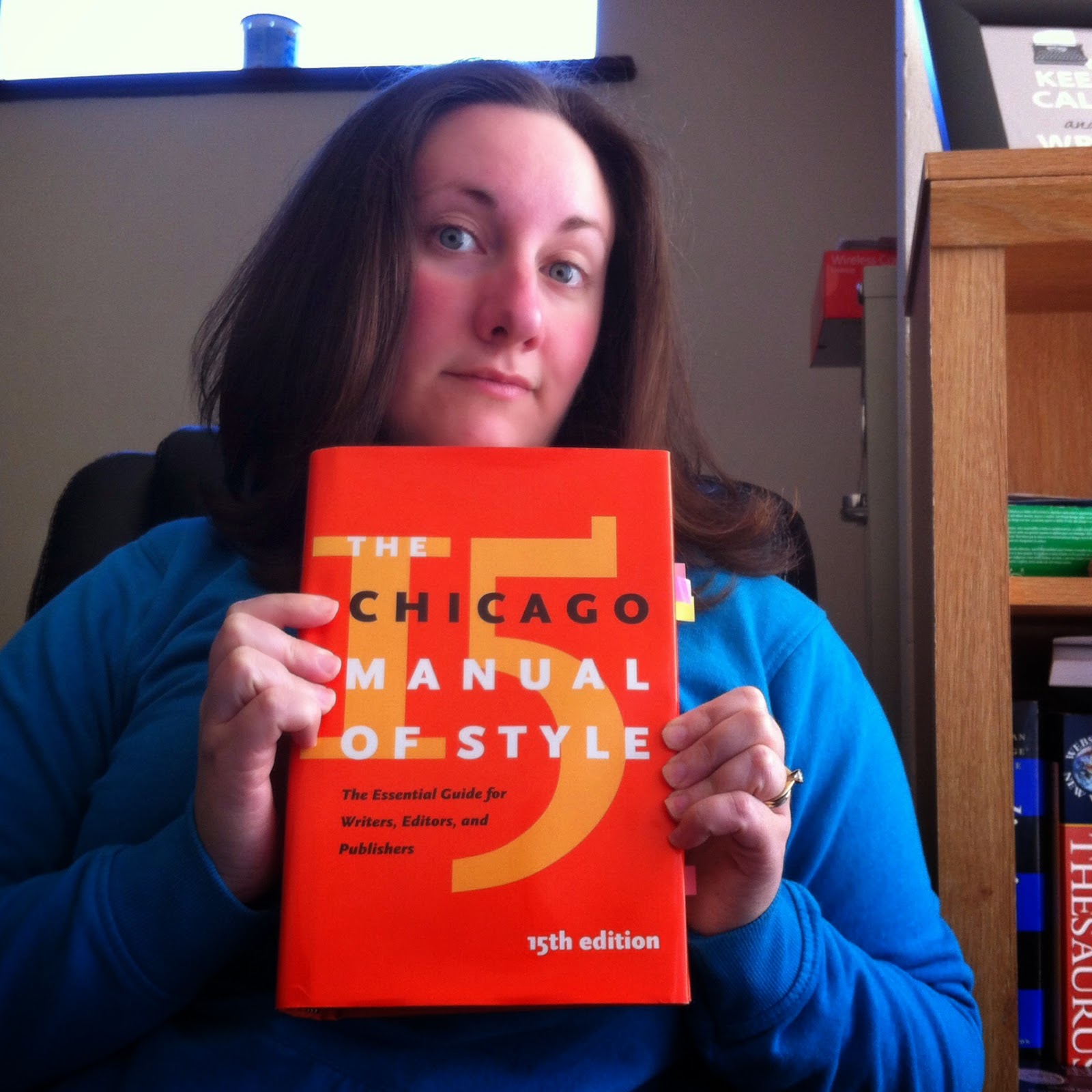
Why do I look so "meh" in this picture? Because this book, while extremely comprehensive in terms of what it includes, extremely detailed, extremely large, and extremely useful, is also an extremely big pain in the ass.  Have I mentioned it's extreme?

If you don't know exactly where to look for the information you want, and it's not readily visible in the index at the back, finding what you want is a nightmare.  I often have to ask someone who has used it longer than I have where to find something in it--which often includes me asking them the question I was trying to find in the book in the first place because it's faster.  Then again, I have a bunch of lovely editor friends to irritate with these questions, so you may not have that luxury.  Also visible in the picture are some of the (many) sticky-note tabs I've marked pages and sections with so I don't have to go through the whole needle-in-a-haystack process again when I need the same info in the future.  If you buy this with other editing books, you'll get a lot of use out of it, though likely as a definitive answer for more obscure grammar rules.  Don't forget, I get paid to use this thing (this is the book the publisher I edit for uses as a reference), and my need for it will likely be greater than your average writer, though it might be worth a purchase anyway.

2) Painless Grammar by Rebecca Elliott, Ph.D.

I'm much more excited in this picture, and that's because this book is what most writers will need.  Most common grammar errors are addressed in easy to follow examples and situations...as the cover says, it's a "painless examination of parts of speech, sentence construction, and punctuation".  I reach for this one over the CMoS most times, though it's not quiiiiite comprehensive enough to be the only reference for someone who edits for a living, or for an author who wants to do a hardcore edit of their own work.  Again, I've sticky-note-tabbed some of my favorite breakdowns, including the explanation of "lay" and "lie" that I can never keep straight.

Plus, bonus points for the cat on the cover.


3) The Elements of Style (fourth edition) by William Strunk, Jr. and E.B. White

Yes, this E.B. White is the same guy that wrote Charlotte's Web, the book that reduced me to tears with every childhood re-read.  Thankfully, his and Strunk's writing style guide doesn't have the same reaction.

First of all, this book was recommended to me by Stephen King--sadly not personally, but through book #4 which I'll discuss in a bit.  If it was good enough for one of the most successful authors of modern times, it was good enough for me.  Strunk & White's book is short--the main part clocks in around 85 pages, not including the glossary at the end.  The breakdown includes Elementary Rules of Usage (including colons, dashes, apostrophes, etc.), Elementary Principles of Composition (including paragraphs, active voice, tenses, etc.), A Few Matters of Form, Words and Expressions Commonly Misused, An Approach to Style (including revising and rewriting, placing yourself in the background, not overwriting, over-explaining, or overstating, etc.), and the glossary at the back. There's a lot--and I mean a LOT--of direct, simple, straightforward information packed into this little book.  It's perfect for transporting, and, stacked up, about 6 or 7 will fit in my CMoS--I measured.

Again, this is the style guide Stephen King recommends, and with good reason.

4) On Writing by Stephen King

The book I'm enthusiastically pointing to is one of the best writing guides--which, oddly, isn't exactly that, nor is it a memoir or autobiography. The cover calls it "a memoir of the craft" and includes plenty of anecdotal stories by King about how he began writing in his youth, and the experiences that shaped his writing and his writing style.  But it's not all about him--he talks about what worked for him, and what doesn't or didn't, and doesn't bullshit or coddle the reader into thinking anything other than hard work and the labor of love will get you success...and maybe not even then.  I can't explain what exactly is so good about this book, but I couldn't put it down once I began reading it.  I can't recommend this book enough for any writer, no matter what genre.  Everyone will take away something different from this book.  Buy it...but finish reading this blog post first.

5) Indie Author Survival Guide by Susan Kaye Quinn

Sorry guys, no picture for this one. I have the ebook version, which I bought before it was available in paperback (which it currently is, though obviously the links within the book won't work in paper form unless you know something about books that I don't).

If you're even considering self-pubbing--maybe you're a beginning author and don't want a publisher; maybe you're a prolific author with a long back-list you've gotten the rights back to and want to self-pub; maybe you have a few traditionally published books but want to be well-rounded--whatever your reason, this book is a must-read for writers.

SKQ is a friend of mine (I guess you could call that a disclosure, though I'm certainly not receiving payment for this blog post or anything else), and she's been self-published before it was really a thing writers did. She's had a lot of time for trial and error, and has found things that have worked well for her and things that haven't, as well as things that did work but no longer do, and vice versa.  She addresses the changing face of self-pubbing and most every aspect you might, as a prospective self-publisher, have questions about.  SKQ has always been up front and eager to help writers, no matter what stage they're at, through her blog, and this book is an extremely organized (and updated) collection of her blog posts.

As I said, if self-publishing is even remotely on your radar, buy this. I've recommended it to many author-friends who have had nothing but good things to say about it.

That rounds up my favorite writing and editing guides (for now, at least)! Tell me in the comments what your favorite go-to reference is.  I'm always looking for new ones!

xoxo Sarah


Other posts in this series:

Part 1: Look it up!

Part 2:  Read it out loud.

Part 3:  Have someone who knows what they're doing read it.

Part 4:  Consistency, consistency, consistency!

Part 5:  Dialogue tag...you're NOT it!

Part 6: Pick the right word to say what you mean.

Part 7: Adverbs--Kill it with fire!

Part 8: Editors Aren't Perfect

Part 9: Frequently Seen Errors (FSEs)

Part 9.5: FSEs Pt.2

Tuesday, December 30, 2014

Tips for Editing Your Manuscript from a Real-Life Editor, Part 9.5

Part 1: Look it up!

Part 2:  Read it out loud.

Part 3:  Have someone who knows what they're doing read it.

Part 4:  Consistency, consistency, consistency!

Part 5:  Dialogue tag...you're NOT it!

Part 6: Pick the right word to say what you mean.

Part 7: Adverbs--Kill it with fire!

Part 8: Editors Aren't Perfect

I had quite a few that I thought would be helpful, so here's the second half of Part 9: FSEs (Frequently Seen Errors)


Men who sound like women

As a woman who frequently writes male perspectives, it's a (fun) challenge to get in their heads and write from their point of view. But we've collectively read so many stories where the male characters are basically women with penises. So, if you're writing a man, try very hard to see things from their perspectives. How do they think? A man who is describing a woman's clothing would notice different things than a woman would--is the dress tight, pink, and short? He's not going to notice that it's peach, chiffon, or tea-length (unless the character is a fashion designer or something). When in doubt, ask a man--brother, father, son, husband, whoever--to describe something, or how they'd say something. It'll probably be short and sweet. There are lots of great posts out there on how to write men, so hit up Google.

Over-reactions as a major plot device

People--both real ones and the ones you've created in your manuscript--make mistakes and misinterpret things. We get that, we really do, and they're okay in small doses. It helps create some mild conflict so we get to see who the characters are. But using a huge misinterpretation or something similar leading to an overreaction as a plot device is getting stale. There are soooo many movies and books that do this that it's pretty played out.  You saw your man having coffee with a woman in a Starbucks you happened to walk by?  Yep, better freak out and overreact and assume he's cheating on you rather than: 1) going in and saying hello; 2) mentioning it to him later on when you're alone; or 3) anything else a real, sensible adult would do. Common plot twist discovered later: she's his sister/lesbian best friend/happily married boss, and that overreaction was all for naught. Huh. Who woulda thought?

Play-by-plays

Collectively, we agreed that we don't need to hear about everything the characters are doing. One of the freelance editors I was speaking with mentioned a page-long (several paragraphs in Word) meal scene she read where nothing major happened, certainly nothing necessary to the plot. But there were descriptions of what the characters were eating, how they were eating, everything. There was a whole play-by-play scene that did nothing that "X, Y, and Z had pizza for dinner before going out" couldn't have done. Again, we realize you're probably looking to pad the word count, but if you find a scene like this, cut it down. Description is often good and important, and it might take practice to find these stray scenes, but do your best.

Simple punctuation errors

Why would this drive an editor crazy? Because it's so easy to look up. It's almost cliche at this point, but there's a big difference between "Let's eat Grandpa!" and "Let's eat, Grandpa!"--mostly cannibalism.  Please, for the love of Jesus on a Velociraptor, if you want any editor or publisher worth their salt to take you seriously--or, if you're self-pubbing, for the readers to not tear you a new one in your Amazon reviews over your shitty grammar skills--look up how to properly punctuate--especially around dialogue. And please...apostrophes aren't necessary to make something plural. Really. Please stop abusing them. What have they ever done to you?

Excessive name or nickname use

Think about the last conversation you had with a person or even a group of people. Now think about how many times you actually said one of their names out loud, especially if it was just you and the other person. Maybe once? If it was a group, maybe a few times--if that--to specify who you were talking to? Keep this in mind when writing dialogue scenes, as this often gets out of hand. It's easy enough to tell who's talking if you use tags like "Brian said" or "Melanie asked". If there's a group, you can probably get away with using names more often, or to specify who is talking to whom, but keep it to a minimum. Your readers will thank you for it.

As for excessive nicknames, they can actually confuse the reader, especially if you have a large cast already. The readers will likely wonder, "Who is this?" and get frustrated. If you have a character named Katherine, it's logical that some people would call her Kate. But it's probably not necessary for her to also be called K-Dawg, Special K, and Katy-Kat by other characters.

I hope this little peek into frequently seen errors has helped you out!

What do you think?

xoxo Sarah

Saturday, December 27, 2014

Tips for Editing Your Manuscript from a Real-Life Editor, Part 9

Part 1: Look it up!

Part 2:  Read it out loud.

Part 3:  Have someone who knows what they're doing read it.

Part 4:  Consistency, consistency, consistency!

Part 5:  Dialogue tag...you're NOT it!

Part 6: Pick the right word to say what you mean.

Part 7: Adverbs--Kill it with fire!

Part 8: Editors Aren't Perfect


Here's Part 9: FSEs (Frequently Seen Errors)


I was chatting with some friends in the freelance editing world recently, and the subject of common mistakes we see over and over in our various projects came up. Basically, these were frequently seen errors (I'll call them FSEs because I like to throw an acronym in now and then) that we saw in manuscripts--grammar, spelling, punctuation, plot, pacing, phrasing, you name it. We've all been doing this a while, so we notice trends.

And I thought that since this is a series on how to self-edit, it could maybe do some good in helping folks see if they're doing any of these things that drive editors crazy.  Because a lot of what we freelancers do--besides the standard grammar/spelling/punctuation-nitpicking--involves the stuff that makes a story good.  And we all know that you guys want to write good stories (that have excellent grammar/spelling/punctuation too, of course)!

Just for a little background so you know we know what we're talking about, the lovely freelance editors I spoke with and I cumulatively have 10+ years editing (of all kinds, and all genres) experience between us.

Info-dumping

This is one that came up a few times and I know I'm guilty of as a writer--when I write something, before it's edited, I generally have tons of information in clumps. I want the reader to know allthethingsimmediatelyOMG. I've shoveled it when I should have sprinkled it, and it doesn't do the story any good. Trust me. Spread it out--one of the things that keeps the readers reading is if they don't have all the information at once. Oddly, this usually happens with character back-story.

Gestures

Characters making gestures is natural--they're "people", after all. But too many gestures, or too much physicality, can take the reader right out of the story. Are your characters constantly touching each other, or rolling their eyes, or any number of other physical things/gestures, especially if dialogue is interrupted to stick those gestures in there? Get another person to read it to make sure it's not too much, especially if it distracts from the story. Another big positive: If you limit writing gestures, then it will also make the ones you do include more powerful and meaningful.

Eye stuff

This deserved it's own category. There's often so much about characters LOOKING at each other. Gazing. Staring. What have you. Let the reader fill in the blanks to picture what's going on, and stop giving the reader the impression that the characters are trying to hypnotize each other. Eye-rolling, also. Limit this to, like, almost never. Trust us. If you need to show exasperation, there are much better ways to go about it. The Emotions Thesaurus is awesome for this.

Mouth stuff

At the risk of sounding dirty, mouth stuff is another thing we kept seeing. Mouths popping open in surprise. Mouths gaping. Jaws dropping. Again, how many times does this happen to real people, and, again, there are better ways of showing surprise.

Both writing that undermines the reader's intelligence AND writing that's pretentious

Both sides of the coin can be hard to deal with as both a reader and an editor, and a happy medium must be struck. If you dumb your writing down and spoon-feed the story to the reader, they're going to be insulted.  On the other hand, if you use words you'd see on the SAT and you're writing a cook book, again, probably time to reevaluate.  Take-home message: Readers are smart, and don't write for the lowest common denominator.

"...think to myself..."

We agreed that the only appropriate use of this would be if you're writing a story involving telepathic characters--in other words, when you might actually need to clarify who the character is thinking to. Otherwise, who the heck else would they be thinking to?  "I thought" is just fine.

Adverbs

Read this: Part 7: Adverbs--Kill it with fire!  Enough said. Yes, we get that adverbs help pad your word count. Still, don't do it.

Sex scenes

Why is this on here? Because you'd be surprised the number of scenes we've read that aren't quiiiite up to par. What do we mean? Sometimes you'll run across one with a position that's not physically possible (and not even in the realm of fantasy--like, the guy would have needed to sprout a third arm or something), or that uses the word "moist".


Need some help writing erotic or sexy scenes without fading to black, no matter how tame or kinky? There are tons of guides on Amazon, so check them out.

I'll be doing a post on this soon, probably after the new year, so keep an eye out for it.

This concludes the first half...I didn't want the post to get too long. The other half should be up soon!

Are these helpful? What do you think?

xoxo Sarah


Monday, December 15, 2014

Tips for Editing Your Manuscript from a Real-Life Editor, Part 8

Part 1: Look it up!

Part 2:  Read it out loud.

Part 3:  Have someone who knows what they're doing read it.

Part 4:  Consistency, consistency, consistency!

Part 5:  Dialogue tag...you're NOT it!

Part 6: Pick the right word to say what you mean.

Part 7: Adverbs--Kill it with fire!


Welcome to Part 8: Editors Aren't Perfect.


I'm often asked whether anything trips me up as an editor. And the answer is, unequivocally, YES. There are just some things that, even after repeated hammerings-in, just don't make it into my thick scull.

I'm not afraid to admit that I don't know everything related to writing, but that's why I own copies of several different editing and/or style guides.

But what stumps me? What's bookmarked and dog-eared in my editing reference books?

I'll tell you.

Keep in mind that these are just a few things, and, for the sake of brevity, I'm not going to go into detail on the correct meanings or usage of them--feel free to look those up, though I might stick a link or two in there if I feel like it.

Lie and Lay  

For the life of me, I can't keep this one straight, especially since the different tenses of the different words are often the same or cross-overs. This has to be one of the most-visited section of my editing guides, particularly because I have to look up the proper usage each time one of these (or a tense) is used.

Affect and Effect

Ugh. This one. Every time I use one in my own writing, even a freakin' Facebook post, I have to look it up. Drives me crazy that I can't keep this straight.

Time Format

Should it be AM/PM? a.m./p.m.? am/pm? Where does it go in relation to the actual numerals? This one is a frequently visited page when it comes up, which, thankfully, isn't often.

Colons and Semi-Colons

I've been told before that I sometimes misuse semi-colons, and I'd rather not use them at all than use them incorrectly. Colons are used so infrequently (unless it's with time) that when I see one used with a list or something else, it's an automatic look-up. Personally, I'm not a fan.

Em Dashes 

Usually these don't bother me and are more of a stylistic thing I rather like using in my own work, but they sometimes trip me up when wondering where to place them in dialogue that has been interrupted by something, typically a character's action.  Though, oddly enough, it makes a difference whether the dialogue stops completely for the action to take place, or whether the dialogue continues on, and the interruption is more of a note for the reader. Complicated? Not really. Hard to keep straight? Yep.

Example showing more of a "dialogue note" interruption, straight out of my CMoS 15 that I consult regularly: "Someday he's going to hit one of those long shots, and"--his voice turned huffy--"I won't be there to see it."  Blogger is weird and won't let me use a proper em dash, but the little hyphens there are the same thing.


This obviously isn't a comprehensive list, but there you have it!

What grammar/spelling/punctuation thing leaves you stumped every time?

xoxo Sarah