Showing posts with label traditional publishing. Show all posts

Friday, May 8, 2015

Tips for Editing Your Manuscript from a Real-Life Editor, Part 11

Welcome back to our (ir)regularly scheduled programming! 

As always, the links to the other parts in this series are at the bottom of the page.

This is Part 11: Sit on it.

No, I don't mean that in a weird rude way. 

We, as authors/writers/whatever you want to call yourself, are generally too close to our own writing to get any perspective.  You know how when you read a book (doesn't matter what kind) and can pick out errors? That's because you're a set of fresh eyes on it. 

And with our own manuscripts, there comes a time when you're literally unable to continue editing it because you're too close to the story, characters, and everything else.  At this stage, it's extremely frustrating--and bad for your manuscript--to keep going. Trust me on this. 

So, in order to get something close to a fresh set of eyes when you're the only one around to edit your manuscript, or before you send it to an editor you've hired, or what have you, you need to distance yourself from your work.  Let it sit for a while.  

The time period can vary from author to author; I prefer at least a couple of months; some authors I know let it percolate for a few weeks while they draft or outline another story. I'm aware of others who got to the point where they hated their manuscript, set it down for a year or more, and finally picked it up and edited it into something they were happy with.

I've recently started on what I feel will be my final run-through (before any kind of publication, self or otherwise begins) on my novel, Fate's Awakening. This is the first time I've really--really--looked at it as a whole in a number of months, and I'm surprised that I like what I've written. It's getting a few tweaks here and there, but nothing major (at least until it hits another editor).  See, the last time I looked at it, I hated it. I wanted to hit delete on the whole thing, and that's how I knew it was time to step back.

So, if you're done with your manuscript, schedule some time to take a break from it and sit on it for a while. Work on something else, then come back to it.  It'll do wonders.

I know this one was a shortie, but, as always, I hope it was helpful!  Let me know what your ideal "sit on it" period is in the comments. I know it's different for everyone!

xoxo Sarah


Tuesday, February 17, 2015

Tips for Editing Your Manuscript from a Real-Life Editor, Part 10

Things were getting out of hand with listing the links at the top of each post for the previous posts, so I've moved them to the bottom. Don't worry, they're still there.

When I started this, I never thought I'd reach this many posts on tips for self-editing, but here's Part 10: Editing and Writing Reference Books

This was a logical progression. After all, I use editing references when I'm editing and when I'm writing, and I thought that since there are so many out there that you guys would appreciate a look at what I use.

Is this the be-all-end-all of writing/editing guides? Hardly. I find new ones occasionally, but these are the books I keep going back to. And if you have suggestions or have a favorite one you use, I'd love to hear about it! Post in the comments to share with everyone.

Here I've picked my five favorites, and I'll nutshell them for you in terms of what I like and what I don't. Easy peasy. I haven't provided links because they're all easy to find. I'd suggest Amazon or half.com and buying used...you're likely just going to mark them up anyway with all your own notes.

Let's begin...

1) The Chicago Manual of Style, 15th Edition
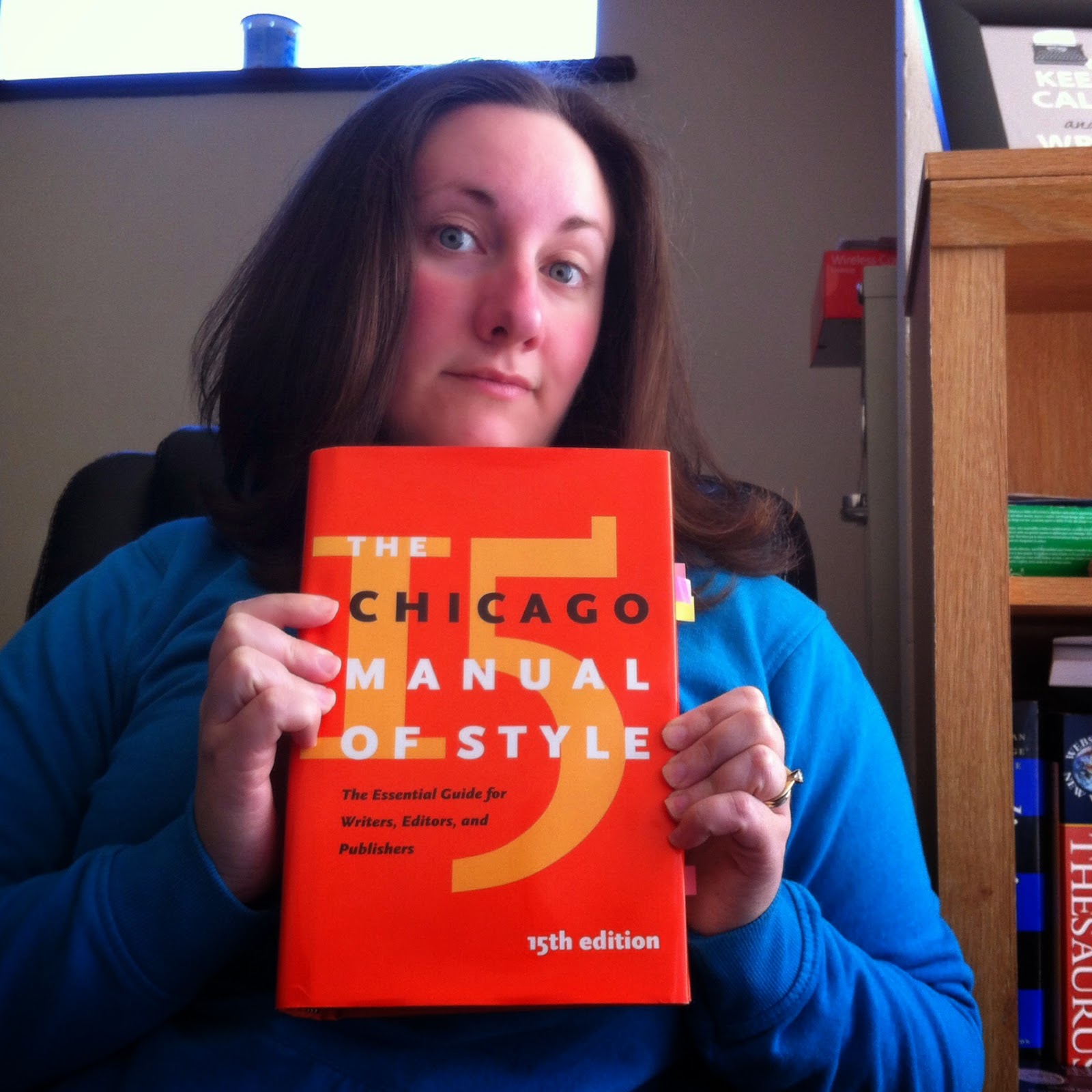
Why do I look so "meh" in this picture? Because this book, while extremely comprehensive in terms of what it includes, extremely detailed, extremely large, and extremely useful, is also an extremely big pain in the ass.  Have I mentioned it's extreme?

If you don't know exactly where to look for the information you want, and it's not readily visible in the index at the back, finding what you want is a nightmare.  I often have to ask someone who has used it longer than I have where to find something in it--which often includes me asking them the question I was trying to find in the book in the first place because it's faster.  Then again, I have a bunch of lovely editor friends to irritate with these questions, so you may not have that luxury.  Also visible in the picture are some of the (many) sticky-note tabs I've marked pages and sections with so I don't have to go through the whole needle-in-a-haystack process again when I need the same info in the future.  If you buy this with other editing books, you'll get a lot of use out of it, though likely as a definitive answer for more obscure grammar rules.  Don't forget, I get paid to use this thing (this is the book the publisher I edit for uses as a reference), and my need for it will likely be greater than your average writer, though it might be worth a purchase anyway.

2) Painless Grammar by Rebecca Elliott, Ph.D.

I'm much more excited in this picture, and that's because this book is what most writers will need.  Most common grammar errors are addressed in easy to follow examples and situations...as the cover says, it's a "painless examination of parts of speech, sentence construction, and punctuation".  I reach for this one over the CMoS most times, though it's not quiiiiite comprehensive enough to be the only reference for someone who edits for a living, or for an author who wants to do a hardcore edit of their own work.  Again, I've sticky-note-tabbed some of my favorite breakdowns, including the explanation of "lay" and "lie" that I can never keep straight.

Plus, bonus points for the cat on the cover.


3) The Elements of Style (fourth edition) by William Strunk, Jr. and E.B. White

Yes, this E.B. White is the same guy that wrote Charlotte's Web, the book that reduced me to tears with every childhood re-read.  Thankfully, his and Strunk's writing style guide doesn't have the same reaction.

First of all, this book was recommended to me by Stephen King--sadly not personally, but through book #4 which I'll discuss in a bit.  If it was good enough for one of the most successful authors of modern times, it was good enough for me.  Strunk & White's book is short--the main part clocks in around 85 pages, not including the glossary at the end.  The breakdown includes Elementary Rules of Usage (including colons, dashes, apostrophes, etc.), Elementary Principles of Composition (including paragraphs, active voice, tenses, etc.), A Few Matters of Form, Words and Expressions Commonly Misused, An Approach to Style (including revising and rewriting, placing yourself in the background, not overwriting, over-explaining, or overstating, etc.), and the glossary at the back. There's a lot--and I mean a LOT--of direct, simple, straightforward information packed into this little book.  It's perfect for transporting, and, stacked up, about 6 or 7 will fit in my CMoS--I measured.

Again, this is the style guide Stephen King recommends, and with good reason.

4) On Writing by Stephen King

The book I'm enthusiastically pointing to is one of the best writing guides--which, oddly, isn't exactly that, nor is it a memoir or autobiography. The cover calls it "a memoir of the craft" and includes plenty of anecdotal stories by King about how he began writing in his youth, and the experiences that shaped his writing and his writing style.  But it's not all about him--he talks about what worked for him, and what doesn't or didn't, and doesn't bullshit or coddle the reader into thinking anything other than hard work and the labor of love will get you success...and maybe not even then.  I can't explain what exactly is so good about this book, but I couldn't put it down once I began reading it.  I can't recommend this book enough for any writer, no matter what genre.  Everyone will take away something different from this book.  Buy it...but finish reading this blog post first.

5) Indie Author Survival Guide by Susan Kaye Quinn

Sorry guys, no picture for this one. I have the ebook version, which I bought before it was available in paperback (which it currently is, though obviously the links within the book won't work in paper form unless you know something about books that I don't).

If you're even considering self-pubbing--maybe you're a beginning author and don't want a publisher; maybe you're a prolific author with a long back-list you've gotten the rights back to and want to self-pub; maybe you have a few traditionally published books but want to be well-rounded--whatever your reason, this book is a must-read for writers.

SKQ is a friend of mine (I guess you could call that a disclosure, though I'm certainly not receiving payment for this blog post or anything else), and she's been self-published before it was really a thing writers did. She's had a lot of time for trial and error, and has found things that have worked well for her and things that haven't, as well as things that did work but no longer do, and vice versa.  She addresses the changing face of self-pubbing and most every aspect you might, as a prospective self-publisher, have questions about.  SKQ has always been up front and eager to help writers, no matter what stage they're at, through her blog, and this book is an extremely organized (and updated) collection of her blog posts.

As I said, if self-publishing is even remotely on your radar, buy this. I've recommended it to many author-friends who have had nothing but good things to say about it.

That rounds up my favorite writing and editing guides (for now, at least)! Tell me in the comments what your favorite go-to reference is.  I'm always looking for new ones!

xoxo Sarah


Other posts in this series:

Part 1: Look it up!

Part 2:  Read it out loud.

Part 3:  Have someone who knows what they're doing read it.

Part 4:  Consistency, consistency, consistency!

Part 5:  Dialogue tag...you're NOT it!

Part 6: Pick the right word to say what you mean.

Part 7: Adverbs--Kill it with fire!

Part 8: Editors Aren't Perfect

Part 9: Frequently Seen Errors (FSEs)

Part 9.5: FSEs Pt.2

Tuesday, December 30, 2014

Tips for Editing Your Manuscript from a Real-Life Editor, Part 9.5

Part 1: Look it up!

Part 2:  Read it out loud.

Part 3:  Have someone who knows what they're doing read it.

Part 4:  Consistency, consistency, consistency!

Part 5:  Dialogue tag...you're NOT it!

Part 6: Pick the right word to say what you mean.

Part 7: Adverbs--Kill it with fire!

Part 8: Editors Aren't Perfect

I had quite a few that I thought would be helpful, so here's the second half of Part 9: FSEs (Frequently Seen Errors)


Men who sound like women

As a woman who frequently writes male perspectives, it's a (fun) challenge to get in their heads and write from their point of view. But we've collectively read so many stories where the male characters are basically women with penises. So, if you're writing a man, try very hard to see things from their perspectives. How do they think? A man who is describing a woman's clothing would notice different things than a woman would--is the dress tight, pink, and short? He's not going to notice that it's peach, chiffon, or tea-length (unless the character is a fashion designer or something). When in doubt, ask a man--brother, father, son, husband, whoever--to describe something, or how they'd say something. It'll probably be short and sweet. There are lots of great posts out there on how to write men, so hit up Google.

Over-reactions as a major plot device

People--both real ones and the ones you've created in your manuscript--make mistakes and misinterpret things. We get that, we really do, and they're okay in small doses. It helps create some mild conflict so we get to see who the characters are. But using a huge misinterpretation or something similar leading to an overreaction as a plot device is getting stale. There are soooo many movies and books that do this that it's pretty played out.  You saw your man having coffee with a woman in a Starbucks you happened to walk by?  Yep, better freak out and overreact and assume he's cheating on you rather than: 1) going in and saying hello; 2) mentioning it to him later on when you're alone; or 3) anything else a real, sensible adult would do. Common plot twist discovered later: she's his sister/lesbian best friend/happily married boss, and that overreaction was all for naught. Huh. Who woulda thought?

Play-by-plays

Collectively, we agreed that we don't need to hear about everything the characters are doing. One of the freelance editors I was speaking with mentioned a page-long (several paragraphs in Word) meal scene she read where nothing major happened, certainly nothing necessary to the plot. But there were descriptions of what the characters were eating, how they were eating, everything. There was a whole play-by-play scene that did nothing that "X, Y, and Z had pizza for dinner before going out" couldn't have done. Again, we realize you're probably looking to pad the word count, but if you find a scene like this, cut it down. Description is often good and important, and it might take practice to find these stray scenes, but do your best.

Simple punctuation errors

Why would this drive an editor crazy? Because it's so easy to look up. It's almost cliche at this point, but there's a big difference between "Let's eat Grandpa!" and "Let's eat, Grandpa!"--mostly cannibalism.  Please, for the love of Jesus on a Velociraptor, if you want any editor or publisher worth their salt to take you seriously--or, if you're self-pubbing, for the readers to not tear you a new one in your Amazon reviews over your shitty grammar skills--look up how to properly punctuate--especially around dialogue. And please...apostrophes aren't necessary to make something plural. Really. Please stop abusing them. What have they ever done to you?

Excessive name or nickname use

Think about the last conversation you had with a person or even a group of people. Now think about how many times you actually said one of their names out loud, especially if it was just you and the other person. Maybe once? If it was a group, maybe a few times--if that--to specify who you were talking to? Keep this in mind when writing dialogue scenes, as this often gets out of hand. It's easy enough to tell who's talking if you use tags like "Brian said" or "Melanie asked". If there's a group, you can probably get away with using names more often, or to specify who is talking to whom, but keep it to a minimum. Your readers will thank you for it.

As for excessive nicknames, they can actually confuse the reader, especially if you have a large cast already. The readers will likely wonder, "Who is this?" and get frustrated. If you have a character named Katherine, it's logical that some people would call her Kate. But it's probably not necessary for her to also be called K-Dawg, Special K, and Katy-Kat by other characters.

I hope this little peek into frequently seen errors has helped you out!

What do you think?

xoxo Sarah

Saturday, December 27, 2014

Tips for Editing Your Manuscript from a Real-Life Editor, Part 9

Part 1: Look it up!

Part 2:  Read it out loud.

Part 3:  Have someone who knows what they're doing read it.

Part 4:  Consistency, consistency, consistency!

Part 5:  Dialogue tag...you're NOT it!

Part 6: Pick the right word to say what you mean.

Part 7: Adverbs--Kill it with fire!

Part 8: Editors Aren't Perfect


Here's Part 9: FSEs (Frequently Seen Errors)


I was chatting with some friends in the freelance editing world recently, and the subject of common mistakes we see over and over in our various projects came up. Basically, these were frequently seen errors (I'll call them FSEs because I like to throw an acronym in now and then) that we saw in manuscripts--grammar, spelling, punctuation, plot, pacing, phrasing, you name it. We've all been doing this a while, so we notice trends.

And I thought that since this is a series on how to self-edit, it could maybe do some good in helping folks see if they're doing any of these things that drive editors crazy.  Because a lot of what we freelancers do--besides the standard grammar/spelling/punctuation-nitpicking--involves the stuff that makes a story good.  And we all know that you guys want to write good stories (that have excellent grammar/spelling/punctuation too, of course)!

Just for a little background so you know we know what we're talking about, the lovely freelance editors I spoke with and I cumulatively have 10+ years editing (of all kinds, and all genres) experience between us.

Info-dumping

This is one that came up a few times and I know I'm guilty of as a writer--when I write something, before it's edited, I generally have tons of information in clumps. I want the reader to know allthethingsimmediatelyOMG. I've shoveled it when I should have sprinkled it, and it doesn't do the story any good. Trust me. Spread it out--one of the things that keeps the readers reading is if they don't have all the information at once. Oddly, this usually happens with character back-story.

Gestures

Characters making gestures is natural--they're "people", after all. But too many gestures, or too much physicality, can take the reader right out of the story. Are your characters constantly touching each other, or rolling their eyes, or any number of other physical things/gestures, especially if dialogue is interrupted to stick those gestures in there? Get another person to read it to make sure it's not too much, especially if it distracts from the story. Another big positive: If you limit writing gestures, then it will also make the ones you do include more powerful and meaningful.

Eye stuff

This deserved it's own category. There's often so much about characters LOOKING at each other. Gazing. Staring. What have you. Let the reader fill in the blanks to picture what's going on, and stop giving the reader the impression that the characters are trying to hypnotize each other. Eye-rolling, also. Limit this to, like, almost never. Trust us. If you need to show exasperation, there are much better ways to go about it. The Emotions Thesaurus is awesome for this.

Mouth stuff

At the risk of sounding dirty, mouth stuff is another thing we kept seeing. Mouths popping open in surprise. Mouths gaping. Jaws dropping. Again, how many times does this happen to real people, and, again, there are better ways of showing surprise.

Both writing that undermines the reader's intelligence AND writing that's pretentious

Both sides of the coin can be hard to deal with as both a reader and an editor, and a happy medium must be struck. If you dumb your writing down and spoon-feed the story to the reader, they're going to be insulted.  On the other hand, if you use words you'd see on the SAT and you're writing a cook book, again, probably time to reevaluate.  Take-home message: Readers are smart, and don't write for the lowest common denominator.

"...think to myself..."

We agreed that the only appropriate use of this would be if you're writing a story involving telepathic characters--in other words, when you might actually need to clarify who the character is thinking to. Otherwise, who the heck else would they be thinking to?  "I thought" is just fine.

Adverbs

Read this: Part 7: Adverbs--Kill it with fire!  Enough said. Yes, we get that adverbs help pad your word count. Still, don't do it.

Sex scenes

Why is this on here? Because you'd be surprised the number of scenes we've read that aren't quiiiite up to par. What do we mean? Sometimes you'll run across one with a position that's not physically possible (and not even in the realm of fantasy--like, the guy would have needed to sprout a third arm or something), or that uses the word "moist".


Need some help writing erotic or sexy scenes without fading to black, no matter how tame or kinky? There are tons of guides on Amazon, so check them out.

I'll be doing a post on this soon, probably after the new year, so keep an eye out for it.

This concludes the first half...I didn't want the post to get too long. The other half should be up soon!

Are these helpful? What do you think?

xoxo Sarah


Monday, December 15, 2014

Tips for Editing Your Manuscript from a Real-Life Editor, Part 8

Part 1: Look it up!

Part 2:  Read it out loud.

Part 3:  Have someone who knows what they're doing read it.

Part 4:  Consistency, consistency, consistency!

Part 5:  Dialogue tag...you're NOT it!

Part 6: Pick the right word to say what you mean.

Part 7: Adverbs--Kill it with fire!


Welcome to Part 8: Editors Aren't Perfect.


I'm often asked whether anything trips me up as an editor. And the answer is, unequivocally, YES. There are just some things that, even after repeated hammerings-in, just don't make it into my thick scull.

I'm not afraid to admit that I don't know everything related to writing, but that's why I own copies of several different editing and/or style guides.

But what stumps me? What's bookmarked and dog-eared in my editing reference books?

I'll tell you.

Keep in mind that these are just a few things, and, for the sake of brevity, I'm not going to go into detail on the correct meanings or usage of them--feel free to look those up, though I might stick a link or two in there if I feel like it.

Lie and Lay  

For the life of me, I can't keep this one straight, especially since the different tenses of the different words are often the same or cross-overs. This has to be one of the most-visited section of my editing guides, particularly because I have to look up the proper usage each time one of these (or a tense) is used.

Affect and Effect

Ugh. This one. Every time I use one in my own writing, even a freakin' Facebook post, I have to look it up. Drives me crazy that I can't keep this straight.

Time Format

Should it be AM/PM? a.m./p.m.? am/pm? Where does it go in relation to the actual numerals? This one is a frequently visited page when it comes up, which, thankfully, isn't often.

Colons and Semi-Colons

I've been told before that I sometimes misuse semi-colons, and I'd rather not use them at all than use them incorrectly. Colons are used so infrequently (unless it's with time) that when I see one used with a list or something else, it's an automatic look-up. Personally, I'm not a fan.

Em Dashes 

Usually these don't bother me and are more of a stylistic thing I rather like using in my own work, but they sometimes trip me up when wondering where to place them in dialogue that has been interrupted by something, typically a character's action.  Though, oddly enough, it makes a difference whether the dialogue stops completely for the action to take place, or whether the dialogue continues on, and the interruption is more of a note for the reader. Complicated? Not really. Hard to keep straight? Yep.

Example showing more of a "dialogue note" interruption, straight out of my CMoS 15 that I consult regularly: "Someday he's going to hit one of those long shots, and"--his voice turned huffy--"I won't be there to see it."  Blogger is weird and won't let me use a proper em dash, but the little hyphens there are the same thing.


This obviously isn't a comprehensive list, but there you have it!

What grammar/spelling/punctuation thing leaves you stumped every time?

xoxo Sarah


Thursday, October 2, 2014

Tips for Editing Your Manuscript from a Real-Life Editor, Part 7

Part 1: Look it up!

Part 2:  Read it out loud.

Part 3:  Have someone who knows what they're doing read it.

Part 4:  Consistency, consistency, consistency!

Part 5:  Dialogue tag...you're NOT it!

Part 6: Pick the right word to say what you mean.

This is part 7: Adverbs--Kill it with fire! 

Or, as Stephen King says in On Writing: "The road to hell is paved with adverbs."

Apply adverbs here...

That might sound like a little extreme, but trust me, adverbs are not your friend. What's an adverb? It's basically the equivalent of what an adjective is to a noun, but it's a word that describes or modifies another adverb, adjective or, most commonly, a verb--how something is done. Often--but not always--they end in "ly".

He walked slowly.  How did he walk? Slowly.

She talked quietly.  How did she talk? Quietly.

You get the idea.

So what's the problem with adverbs? Description is good, right? And I'm always on everyone about showing, not telling (*maniacal laughter* You just wait...there'll be an entry in this series on that too, I can guarantee it).

The problem with adverbs is that there's almost always a better word to use that makes your narrative stronger. See all those words in bold and italics? I even went overboard with the emphasis so you guys would know I'm serious.

And since I'm so big on showing, not telling, I'm gonna show you.  Read the following two narrative paragraphs, and pick the stronger one...

Kylie quietly walked through the house. She'd waited patiently all day for her family to leave. Now, Kylie finally had the computer all to herself. She firmly pressed the button and switched it on, fidgeting excitedly as it slowly booted. The web browser opened suddenly, and Kylie meticulously poked in the address. Yay! Kylie thought happily. Now I can immediately watch my favorite cat videos!

Kylie tip-toed through the house. She'd waited all day for her family to leave. Now, Kylie had the computer all to herself. She pressed the button and switched it on, fidgeting as it booted. The web browser opened, and Kylie poked in the address. Yay! Kylie thought. Now I can watch my favorite cat videos!

The second one is stronger, more direct, and clearer, and that's with only changing one of the adverbs (quietly walked to tip-toed) and just deleting the others. Even better would be to find ways of showing even more using other, stronger, words.

Here's what I mean by that:

Said quietly becomes whispered.

Walked slowly becomes strolled.

By using a single word (or a short phrase) in place of the adverb, it provides a more direct description of what's happening and makes it clearer to the reader.

This post with a giant quote from Stephen King's On Writing, where he talks dandelions in your word-garden and closing the door firmly, takes the cake. Go read it. I'll be watching Nyan Cat until you're done...


...

Back already? Good.

Oh, and like the awesome Mr. King says, for the love of Jesus on a Velociraptor, please don't use them with dialogue tags. For 99% of the time, let the dialogue communicate how someone says something. For the other 1%...well, I guess I can let it slide.

"Fine, Mom, but as soon as I'm done cleaning my room, I'm gonna watch cat videos again," Kylie said dully.

See what I did there? I crossed out the adverb. Why? Because you don't need it. It's clear from the dialogue that Kylie is whining (you could, in theory, use "whined" as the dialogue tag instead of "said", but, again, it's not necessary--her tone is already clear to the reader, and readers aren't stupid).

There are ways around using them, too. Is it recommended? Well, that probably depends on what you're trying to accomplish with the description...

"Of course you'd want to watch cat videos instead of eating pizza with me," Jen said scathingly.

"Of course you'd want to watch cat videos instead of eating pizza with me," Jen snapped.

Is it easy to tell from the dialogue that the words are said "scathingly"? Maybe, maybe not. But in cases like this, it'd be your call whether to use an adverb or not. Better yet, change "said" to "snapped" or something like I did. It's not one of those dialogue tags that's too "out there", and it effectively communicates what you're trying to get across about how Jen is saying something.

Let me also say that I'm a huge fan of adverbs...in a first draft. Mine are littered with them. But, because this is an editing how-to tip post thingy, I feel I should emphasize that I try my best to catch them and weed them out (haha, get it? Weed them out? Like dandelions? You'd get it if you read the Stephen King bit above...), replacing the adverbs with stronger language or taking them out completely. So feel free to let your first-draft garden get a bit overgrown...you'll be taking some Round-Up to it when the second draft comes along.

Are you guys finding these posts useful? What are your thoughts on adverbs? Please let me know in the comments. :-)

xoxo Sarah


Wednesday, July 9, 2014

Tips for Editing Your Manuscript from a Real-Life Editor, Part 6.5

Because it's not often that the world says, "Here's a real-life example of that thing you're always talking about! Have at it!", I'm doing a little bonus post here for you lovely readers.

The awesome Dear Abby has a letter up that, I think, a lot of people could have written nowadays. And, quite frankly, this exact letter is why I'm writing this series on editing your own stuff.  The full text of the letter (and Abby's response) is below, though the link back to the actual letter is above, so I'm not plagiarizing, I promise.

DEAR ABBY: My friend's husband has been writing a novel for several years. He just self-published it, and it's available on Amazon. He gave me a copy, asked me to read it and enter a great review on the Amazon page. The problem is the book is filled with misused and misspelled words, and there is missing punctuation. He even switched the names of two characters. (His wife, who is a "perfectionist," was his editor.)
Aside from the fact that I don't want to finish the book, I know he or my friend will ask me how I liked it. I don't want to lie because I'm afraid if someone else brings these things to their attention, they'll know I didn't read it or think I should have told them. I know they will be embarrassed if I bring it to their attention.
Frankly, I think it's too late to say anything negative because the book has already been printed. I also don't want to cause hurt feelings because I know how long he worked on this project and he's proud of it. How do I handle this? -- READER IN THE SOUTHWEST
DEAR READER: He's a friend, right? And you're only a reader, not a literary critic whose credibility will suffer if you don't point out every flaw. Find SOMETHING you liked about the book and mention that on the Amazon page. You could call it a "page turner" because you had to turn from Page 1 to Page 2, didn't you?
In a case like this, less is more. And remember, you're doing this in the capacity of being a friend, not an English teacher.
One thing I noticed that Abby's otherwise good response lacks (actually, the whole letter in general) is the knowledge that, yes, you can re-upload a new copy to Amazon. So, if the author of said bad book does come to his senses and have someone who knows what they're doing look at his work and fix it, he can upload a revised copy. And, as I've seen before on Amazon, reviews will reflect that his book is cleaned up.

I feel that I must add that though I don't think there's anything wrong with asking friends or family to read and review, to give a person a copy of a book and request that they "enter a great review on the Amazon page" is far from fair to the reader. It doesn't give the reader any chance to be honest, and immediately tells me that the author will be far too sensitive to any criticism. If that's the case, he (the author mentioned in the article) is in the wrong business. If you can't handle the heat, get out of the kitchen. Just like when you're applying for a new job and asking people if they'd be okay with giving you a reference, never assume someone will be able to give a positive review. But there's nothing wrong with asking for an "honest, and hopefully positive" review. That seems more fair. Or be prepared to take what you get--professional bloggers and reviewers even put something like "An ARC [ARC=Advance Reader Copy] was received in exchange for an honest review" to make sure that people reading their reviews know they were unbiased--and unbought--by the author.

You're probably wondering what tactic I'd take in this situation. That's a tricky one.  I trust most of my writer friends to be completely honest about my work and I'd be honest with theirs.  We also understand that there's a big difference between someone being a bad writer, and someone's writing not being your cup of tea.  Example: I don't read much inspirational romance, but I'd be able to figure out upon reading one if it was well-written or not.  And I know my writer friends can handle feedback. Also, when I say "honest" I mean I try to be tactful but clear if something isn't working. If someone told me I had errors in a completed book, I'd bust my butt to fix them--a few can be forgivable; I see them in completed published works all the time, but a few always slip through the cracks (a few being the key words). Any more than a few, and you need to fix it. Otherwise, the reviewers will tell you, and they won't hesitate. Trust me on this.

"Just keep talkin', Bob. Just keep talkin'."
But back to the letter... Depending on how well I knew him, I'd probably say something to him before posting any kind of review, possibly taking a route that allowed him to save face.  "Hey, Bob, I'm part-way through your book, but I noticed some errors. Maybe you accidentally uploaded a pre-edited version?" Do I really think that's what happened? Not on your life. And if he's smart, he'll take the hardly-subtle hint and fix it.  But he's obviously sensitive to criticism (he asked for that "great" review, after all), and even if I'd said something in my theoretical Amazon review about anything being less-than-perfect, he'd still likely corner me at the next BBQ we ended up at together, grill me (haha, see what I did there?) about what that meant, and then passive-aggressively complain, defending his book and his "perfectionist" wife's editing skills until I start daydreaming about strangling him to death with a rack of ribs.

But what if I just go ahead and write the review and don't say anything?  I'd take Abby's tactic--short and sweet. Find something, anything, about the book that I liked, even if it was a small side character or his overall writing style, and write a very short review based on that. Like, a sentence or two. Hey, he didn't ask for a long review, just a "great" one.  And maybe give it four stars instead of five (three, and he'd see it and we'd be doing the BBQ scenario all over again). Your relatively neutral review will likely be fine with him, and it will allow other readers and reviewers to fill in the gaps you so conveniently left in your own. And they will. Oh, they will.

Does this mean that every book I rate on Goodreads or Amazon with a four-star/short review is because of this? Absolutely not. I'm lucky to be able to squeeze out a few minutes to write this blog, much less review everything I've read lately.  I do my best to, but something has to give. And, like I said above, I'm honest in my reviews. So, if you're looking for something new to read, do what I do--read ALL the reviews (or at least the "most helpful" or "most recent"ones) and make a judgement call for yourself.  What someone loved, you may not; the reverse is just as often true.

Oh, and here are the rest of the posts in this series. If I'm able to help one person with their editing, then I've done a good job.

What do you think of Abby's answer? What would you do in this situation? I'm curious!

xoxo Sarah


Monday, June 30, 2014

Tips for Editing Your Manuscript from a Real-Life Editor, Part 6

Since it's been a while, before we begin, here are the links to the others in this series. You can also search by the tags.  Either way is fine.

Part 1: Look it up!

Part 2:  Read it out loud.

Part 3:  Have someone who knows what they're doing read it.

Part 4:  Consistency, consistency, consistency!

Part 5:  Dialogue tag...you're NOT it!

This is part six of my series, Tips for Editing Your Manuscript from a Real-Life Editor, and this time, I want to drill  into your brains the importance of actually using the word you should be using.

Part 6: Pick the right word to say what you mean.

This simple task, when employed with your manuscript or article or whatever you're writing, can save you a lot of trouble.  Acquisitions editors will think you're awesome and be more likely to contract your work; your readers will tell their friends to read your work because you're so well-spoken; your grandchildren and great-grandchildren will tell stories around the campfire about your legendary grammar skills...

Okay, maybe not that last one, but you get the idea.

Hey, I know you guys are smart--just do a little research and that will go a long way.  In other mediums, like blogging or texting or tweeting or Facebooking, it helps you not look like a moron or like you don't care.  No, I'm not exaggerating; that's what I think when I silently judge people's writing. I can tell the difference between someone who knows their grammar and simply got screwed by auto-correct or made a typing error because they were in a hurry (both happen to everyone,  myself included), and someone who has no idea how words work.

Now, I'm pretty sure I touched on this subject a bit in Part 1 (see the links above), but I wanted to go a little more in depth here.

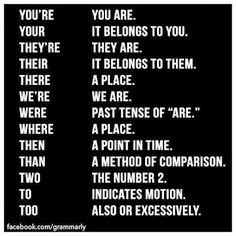
The most common errors I see are the ones you mostly see as well: you're, your, they're, their, there, we're were, where, then, than, two, to, too.  This handy-dandy guide takes all the guesswork out of it.


And while you're at it, go ahead and "like" the Grammarly page on Facebook.  That's where that graphic came from, and they're awesome.

There are also commonly confused words and homophones.  These things give me trouble too; I can't use "accept" or "except" or "affect" or "effect" without having to look them up.  It's getting irritating, but for some reason they just don't stick in my head.

But never fear!  Here are two handy links to help.

This one helps with commonly confused words.  The most common one I see as an editor is "farther" and "further", though there are tons.

This one is all about homophones.  Homophones are words that sound the same, but are spelled differently and mean different things.  "Waist" and "waste" are biggies...no one wants to read about the hero in your romance novel putting his hands around the heroine's waste.  That's just gross.  You want to make your readers smile, not gag.

If there was EVER an appropriate time to use this picture, it's here.

Hope this one was helpful!  Do you have a word that constantly trips you up?

xoxo Sarah

Monday, January 13, 2014

Tips for Editing Your Manuscript from a Real-Life Editor, Part 5

Since this little editing series is clearly getting away from me, I'm just going to make these links to the previous entries a permanent fixture in the beginning of each one.  Yay for easy access!

Part 1:  Look it up!  

Part 2:  Read it out loud.  

Part 3:  Have someone who knows what they're doing read it.  

Part 4:  Consistency, consistency, consistency!

And now, introducing...

5) Dialogue tag...you're NOT it!

Have I mentioned I love puns?

Anyway...

A dialogue tag is a little verb that assigns speech to a character.  Here's a great article on them that's definitely worth the read, but I'm going to go over them in general terms.  I will also assume that whoever is reading this is reasonably skilled at writing and is now in the editing process.  This is, after all, an editing tips post, and I'm assuming that we're working with a finished manuscript and it's being edited and cleaned up.  I'm a big proponent of writing what comes out of your head and cleaning up your manuscript later.  Sometimes it's worth it to get those beautiful words down and make them shine afterwards.

While there's nothing inherently wrong with using dialogue tags (DTs), the two most common problems I encounter with them (as en editor) are:

1) Overuse
and
2) Redundancy

Let me explain what I mean by these things, and I think I'll do that best with an example.  I'm going to write a short scene between two characters, and then I'll critique it for you.

"I have a confession to make," whispered Kara as she leaned closer to Mary.  "I love watching cat videos on the Internet."

"Really?" asked Mary, frowning.  "What kind?"

"Any kind," confessed Kara, covering her face with her hands. "Maru. Grumpy Cat. Cats with string. Cats in boxes. Cats playing with laser pointers. It's gotten out of control!" she wailed.  

"Don't worry," Mary told her with a smile. "I watch them all too. So let's find some free WiFi and we can watch some together."

Okay.  Let me address the issue of "overuse" first.  A writer will often use DTs to help designate who is speaking, especially if there are more than two characters having a conversation.  And that's fine.  However, in the editing process, it's worth a look to see when (or even if) it's ever confusing for the reader to figure out who is speaking.  This may be a case for my Part Three post where you get another set of eyes on it, but an author should be able to do this reasonably well on their own.  Also, if paired with an action the speaking character is doing, a DT isn't really necessary.  And unnecessary DTs drag down the pace of your manuscript, especially in action scenes.  Don't get bogged down with them.

Redundancy.  Most often, TDs are rendered redundant by the actions of the characters or other punctuation the author decides to use.  The first DT I used above is "whispered", and while I'm a big fan of using specifically descriptive DTs (example: "whispered" instead of "said quietly"), this one isn't needed at all.  It's clear from the scene that Kara is speaking quietly...people don't usually shout a confession.  "Asked" was the second one, made redundant by the question mark at the end.  It's obvious Mary is asking something, and there's no character confusion here about who is speaking.  "Confessed" is the third, and again, it's obvious Kara is confessing to Mary about her cat video-watching obsession.  Not needed, AND it's too specific.  When you use dialogue tags, it's best to stick with the tried and true simple ones: said, asked, and similar ones.  Let your characters' actions do the talking.  Don't get over-flowery or you risk coming across as a writing amateur.  The same thing with "wailed."  It's pretty specific, and Kara's anguish comes across with her actions and the exclamation point at the end (which are fine to use sparingly).  "Told" is the last one, and just not necessary.  Once again, it's obvious who the speaker is when paired with the action.

Now here is the exact same scene, but with NO dialogue tags at all.  See the difference?

"I have a confession to make."  Kara leaned closer to Mary.  "I love watching cat videos on the Internet."

"Really?" Mary frowned. "What kind?"

"Any kind." Kara covered her face with her hands. "Maru. Grumpy Cat. Cats with string.  Cats in boxes.  Cats playing with laser pointers.  It's gotten out of control!"

"Don't worry." Mary smiled at Kara.  "I watch them all too. So let's find some free WiFi and we can watch some together."

The message of the scene is clear, and the actions speak loudly for themselves.  There is no confusion about who is speaking.  Could a writer use dialogue tags here?  Sure.  But sparingly.  Sprinkle them in your manuscript, don't shovel them.

What's your take on dialogue tags?  Love them?  Hate them?  Avoid them like the plague?  How about cat videos?  Do you like those as much as Kara?

Here are pictures of Maru and Grumpy Cat for good measure.  Because cats.

Maru in a box, like usual.


I hope you all are finding these editing tips and things to watch out for to be helpful!

xoxo Sarah

Friday, January 10, 2014

Tips for Editing Your Manuscript from a Real-Life Editor, Part 4

Whoa! Someone's on a blogging roll now!

Part 1 of this series of entries on how to do a great job of editing your manuscript to ready it for publication (self-pub or traditional publishing, makes no matter to me), discussed looking up things you don't know, or verifying information.

Part 2 was all about looking like a crazy person (hey, if you're a writer, you already hear voices in your head...) and reading your work out loud to yourself to catch errors, especially in dialogue.

Part 3 went over having someone who really knows what they're doing look your manuscript over.

And part 4 is about...

4)  Consistency, consistency, consistency!

Um, okay, but what the heck does that even mean?

One way to interpret that is to write consistently (a bit every day) and edit consistently as well.  And that's awesome advice, but that's not how I mean it.

Because this series is about editing, I'm begging you to use versions of words consistently.

For example, have you ever written "pony tail" to describe a woman's hairstyle?  Or maybe you wrote it as "ponytail" instead?  How about "no one" or "no-one"?  Do you write "OK" or "okay"?  Or maybe "Goddamn" or "goddam" or "God damn" or any of the other countless variations?  And did you write these words multiple times in your manuscript?  Probably yes, right?  Do you see my point?

Most of the time it doesn't matter how you write them (though some of these definitely have spellings that are more accepted than others) but you need to write these words the same each time you use them.  They can be tough to catch, and are often caught in the later stages of editing when your manuscript is (mostly) done, but it's worth paying attention to.

When I'm editing a manuscript, be it my own or someone else's, and I come across one of these, I'll do a global search for them.  I can hear you asking how you do that.  It's pretty simple.  In your Word doc, click "find" in the upper right of your "home" screen (or try "CTRL F") and type in the word you want to find. You'll be able to tab through each instance of the word.  Then do a search for the other variations of the word.  Didn't find any?  Good.  You've been writing it consistently.  Found some?  That's okay!  Just pick which one you want to use (or whichever one is "accepted" or "correct") and change them all to that one.

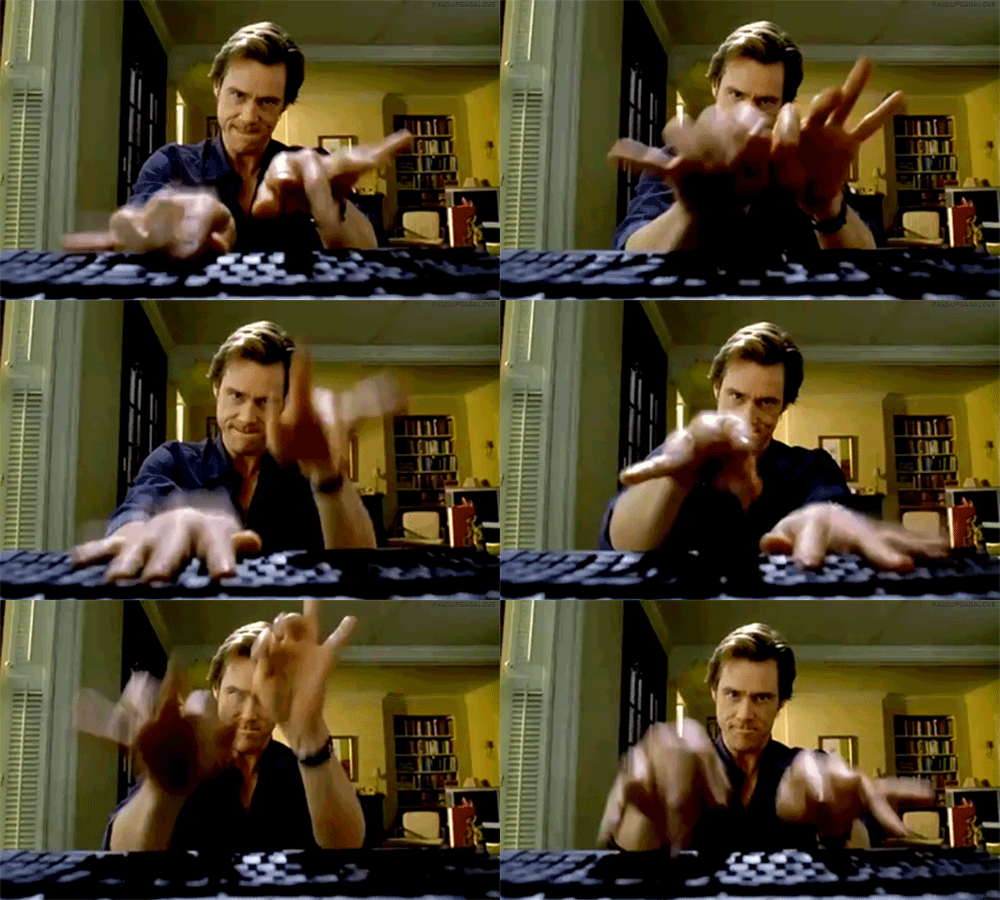
What it's like when you find the one time you spelled something differently, but less cute.

Why is this important?  After all, it reads the same whether you write "ponytail" or "pony tail", right?  Because it's about the integrity of your manuscript.  You want it to be all clean and matching and, whether you notice it or not, if you're not consistent in your wording, it'll come across like you didn't care about how polished your manuscript was.  Like you didn't bother to read it over before you sent it in.  And that can matter when you're querying agents or publishers or, if you're self-pubbing, it can matter if you want readers to return to your online outlets and buy and read more of your work.  I don't like to return to stores that look like they don't care (unless I absolutely have no choice), so why would I return to an author who doesn't either?

What your manuscript will bring to mind if it's not cleaned up.

I've done it too.  When I was starting Fate's Awakening, I didn't really pay attention and I ended up writing both "soul mate" and "soulmate".  Microsoft Word didn't seem to care either way, but I did, and I changed them all to the two word version for consistency's sake.

Don't like the idea of having to comb through your manuscript for these words?  When you're starting a new story, make note of which version of the word you're using, and reference that when you go to write it.

What are your thoughts on consistency in your wording?  Do you have a particular method of catching these "oopses"?  Tell me your strategy!

xoxo Sarah

Thursday, January 9, 2014

Tips for Editing Your Manuscript from a Real-Life Editor, Part 3

To recap, the first tip for doing a good job on editing your own manuscript encouraged you lovely writers to look it up.  The second one wanted you to read your manuscript out loud to yourself.

Onward to the third one!

3) Have someone who knows what they're doing read it.

And by that, I mean a professional editor, or a beta reader, or a critique group in your local writer's association, or some form of one of these things.

I can't tell you the number of times I (and my fellow editors...yes, we talk about this stuff) have heard some variation of:  "Thanks, but I can't afford [your services] right now, so I'll have my friend who's an English major/English teacher/blogger friend/sister in high school who gets straight A's in English/etc. read it over for me. That's pretty much the same thing as what you do, right?"


There's a reason we charge what we do, and that's because we know what to look for in a manuscript.  Depending on the service you're paying for, we can help you with plot/character/writing style critique, grammar/spelling/punctuation issues--the list goes on.  You get what you pay for, and always ask for references.

Other ways to get good feedback are to take writing workshops.  Often there will be critique involved during the "classes" (even the online ones), and you'll get to work and study with other authors who write in your genre.  Sometimes there's a bonus for signing up for one, like the instructor will critique your first three chapters or first thirty pages or something along those lines.

On the other hand, if you're lucky enough to be able to trade services with someone who is familiar with these things, great!  That's a win/win.  You get a chance to learn and work with someone else who can help you as well.  It's much easier to find errors and patterns in another person's work, because you're not constantly reading it and immersed in it.  I've learned so much from editing others' manuscripts that I can apply to my own writing.  Editing has literally made me a better writer.

Otherwise, good luck with asking for help from your English major cousin who posts things like this on Facebook:


Keep in mind that it's awesome to have pre-readers of any kind.  They can give you valuable feedback on whether your manuscript is boring, if it drags in parts, whether your action sequences are exciting enough, if your sci-fi aliens are plausible, etc.  And that's all good stuff.  But they, in no way, should substitute for a quality editing job.

How would I know this is important?  Because a professional editor looked over the first fifty pages of my manuscript (I'd taken a workshop with her and this was a "bonus" for signing up for it), and immediately pointed out that I used the word "some" far too much.  She'd even highlighted every time I'd used it...and WHOA.  There were too many yellow words in my manuscript for my liking.  Did I really use "some" that much?  Apparently.  I was shocked, but it was something I'd never caught in all my read-throughs.  Why?  Because of author blindness, plain and simple.  She brought many other things to my attention as well that helped me immensely with my manuscript, but this one really made me realize that author blindness is a real thing, alive and well.

Let me tell you a little story to illustrate the cumulative importance of all of these editing posts.  I was at a book fair with my publisher last year.  I even had a sweet little badge that said "editor" on it, which was simultaneously exciting and terrifying.  Keep in mind that I am no way in charge of accepting/rejecting manuscripts.  That's for our acquisitions department.  This event was more for industry professionals and networking than for authors, but there were a few writer workshops going on and a bunch of authors were making the rounds at the (many) publishing booths.  Once in a while one of them would stop by our booth, all nervous and excited and, after they found out what we published, would hand us a synopsis of their manuscript and their contact information.  We'd always politely thank them and take the synopsis no matter what.

During some down time we started to read through some of the synopses, and I was shocked at how many of them had glaring problems.  Not wonky formatting or anything like that, but spelling errors, run-on sentences, grammar issues, you name it.  I literally couldn't make myself finish reading some of them (and keep in mind that a synopsis is short--typically 1-3 pages).  And this is the piece that they're handing to publishers in hopes that someone will fall in love with their story--likely something they've been slaving over for a long time--and want to put it out into the world.  Out of the few I read, I probably wouldn't have requested any of the manuscripts based on the errors in the synopses alone.  Think about it--if this piece is their selling point, what condition is the actual manuscript in?  I'd never want to subject an editor to that kind of a job.

You never want to put someone off your work before they've even actually read it, plain and simple.

Have you worked with a professional editor before?  Do you trade critique services with someone?  Is there a point I missed that's good editing advice?  I may address it in another entry.

Tell me your editing strategy!

xoxo Sarah

Tuesday, January 7, 2014

Tips for Editing Your Manuscript from a Real-Life Editor, Part 1

In this new year, I'd like to do more to help my fellow writers.  I've always been inspired by the lovely Susan Kaye Quinn, who has always been so open to assisting other authors who ask for it.  She even compiled a new ebook that combines a series of blog entries (along with new material) to help folks make up their mind whether they want to self-publish or not, and how to do just that.

But what to help other authors with, exactly?  What skill set do I have that I can use for the greater good?

Well, I'm an editor.  A real-life professional one.  So we'll start there.  I'll give a few credentials to start...I'm contracted with a mid-size publisher to edit with them. I do free-lance editing, as well as critiquing in various forms for people.  I've also been part of a team that accepts/rejects online submissions to an online story archive.  So I've been editing in some form or another since 2008.  This ain't my first rodeo.

So, editing...  One of the hardest things to do is edit your own manuscript--or really your own work in general--because of author bias.  We (as authors) are naturally blind to certain things, and have read our own work over so many times that we don't even catch things like missing words.  Feel free to laugh...I've done that myself.  But we're obviously forced to do some editing before anyone who belongs to the publishing industry powers-that-be (an agent or acquisitions editor, for example) sees our work.  It needs to be in excellent shape to be considered for publication, though it is understood that it'll have to go through further editing during the publication process if it's lucky enough to get that far.  But you want to give your manuscript the best chance possible, right?

But then how do authors get their own work in shape to go out into the world? That's where I come in.  These tips are in no particular order, and are a guide to those of you who want to do a good job at self-editing (and good editing ideas in general) before you start querying or officially self-publish your book on Amazon or Smashwords or wherever you're doing it.  Especially with self-publishing, a quality product will translate into higher sales.  Readers have high standards, so strive to meet them.

I'm even going to split this into multiple parts, because I got a bit carried away and this entry became far more detailed than I'd expected.

So onward to the first point...

1)  Look it up.

This may seem intuitive, but we all make common writing errors.  All of us.  No one is immune.  Let me repeat that: NO ONE IS IMMUNE, even you, Super Writer.  So if you're using one of the many commonly misused words, or like to use (or abuse) semi-colons, look it up to make sure you're using them correctly, even if you're pretty sure you are.

Where do I find this information?  Well, when I edit, I reference the incredibly clunky Chicago Manual of Style.  But it's not user-friendly, even for those of us who know what section we're looking for.  Honestly, for most grammar issues, I use Painless Grammar.  The examples in it are easy to understand, and none of it is overly complicated.  However, there are countless grammar books like that one, so find one that works best for you.  And there's always Google, though I'd be more careful with that, unless you're one of those people who trusts everything they read on the interwebs.

"But," you may ask, "don't most manuscripts you see already have this kind of stuff ironed out?"  Well, no.  They don't.  And sometimes I want to put the Cone of Shame on an author.

When I edit a manuscript and return the work to the author, I always include a list of repeated issues I've come across.  By that point I've spent hours--sometimes it cumulatively adds up to days--reading their work over and over, and I feel it's partly my job to point these things out because it can help the author learn and they'll be less likely to repeat these things in future manuscripts.  It makes less work for me (or whoever the editor is who's editing their new work) and the author learns something valuable.  It's a win/win.  In one recent manuscript I had, the author constantly confused further/farther, and I had to do a global search in the document for both words to make sure the correct one was used (or fix it if it was incorrect).  So I made sure to let her know about that when I returned it to her.  This is something that would have easily been fixed by the author taking a few minutes to check which word would have been appropriate.

And before you ask, yes, I do it too. Even with as long as I've been editing, one thing that still trips me up is affect/effect and every damn time I write one of them I have to make sure I'm using the correct one.

What's your favorite reference to use when writing?  Internet?  A particular book?

Point #2 is coming up shortly, so stay tuned!

xoxo Sarah

Saturday, October 5, 2013

Exciting (tiny) format change!

Hey, everyone!

As I get farther into the writing process, the more I realize that so much of this business, and the success of someone participating in it, is based on pimpage.

In a nutshell, authors helping authors.

Therefore, I'm going to be doing occasional posts to help get the word out about my friends' books, particularly the lovely ladies from the Maryland Romance Writers and other RWA chapters I participate in as well as some amazing self-pubbed authors I know.

Why are you doing this, Sarah?  Won't your blog turn into a giant advertisement for other people's stuff?

Will your blog be the equivalent of ALL OF THESE rolled into one?

Well, because of the reason I mentioned above--authors helping authors.  One reason I've joined these groups is for the support of other authors just like me, and that's why they've joined, too.  So much of this wide world of publishing is based on give and take, and I've come to realize I can't--and shouldn't--expect other authors to want to host me and my (eventual) books on their blogs if there's not any reciprocation.  Word of mouth is a powerful thing, especially among others who respect your work as much as you respect theirs.

And why feature self-pubbed authors?  Or, conversely, why feature traditionally published authors?  Answer: Because I believe an author should be well-rounded in publishing nowadays.  You can't put all of your eggs in one basket...for myself, I plan on being both traditionally published and self-pubbed, especially since there are so many success stories.  Both are wonderfully viable options for authors.

You also might be wondering if I'm going to be constantly pushing books that I've edited.  The answer is no.  That might seem like a weird double-standard; after all, I stand to make money from them from sales (in some cases).  But this is my blog, and I stand by the fact that I can feature what I want on it.  When I have a contract of my own--as an author getting a book published, whether it's an e-publisher or one of the Big 6 or however many there are now--then I'll happily feature things from my new publisher on here.  I'm looking forward to that.

Please don't inundate me with emails or whatnot requesting reviews...this is NOT a review blog.  It may feature reviews in the future (I never like to say "never"), but for right now, my time is so limited that I barely have time to squeeze in a little pleasure reading before bed.

So look out for guest posts from other amazing authors in the near future.  But I promise I'll still be posting and being my usual weird, snarky self.  That won't go away.

xoxo Sarah