Showing posts with label Susan Kaye Quinn. Show all posts

Tuesday, May 26, 2015

Five Tips for Success as a Self-Published Author (and giveaway!) by Susan Kaye Quinn


Five Tips for Success as a Self-Published Author
by Susan Kaye Quinn

Can you spot the self-published titles?

Hint: they all are.

(Caveat: A.G. Riddle started out indie but is now published through Amazon's 47North imprint along with Marko Kloos)

The truth is that self-published titles now regularly top the charts - if not outright dominate them. Successful self-published titles have great covers and lots of fervent fans - often the only way to distinguish them from traditionally published titles is the publisher listing in the description (and the price - indie titles are usually less than $5.99 for single titles).

How do you become one of these successful indie authors? Hard work, luck, and educating yourself about how the indie marketplace works.

Here are FIVE TIPS to get you started. For a full run-down on how to launch your indie author career, see my Indie Author Survival Guide (Second Edition now available). To take your indie author career to the next level, pre-order my For Love or Money: Crafting an Indie Author Career (releases 7.14).

TIP #1: Study the Bestsellers - In both craft and business, studying successful people will help you discern the ingredients of success. Always be striving to take your craft up a level - by craft I mean storytelling, not just the way you string words together. Because as much as we like to disparage that poorly written erotica book at the top of the charts, I guarantee that good stories well told actually do sell. (Alternatively, if you want to chase the latest trend, that's possible now  - there's no sin in giving readers more of what they want, but it's nowhere near as easy as you think.) As far as business, look who is selling in your genre and what they did to get there. Don't follow what people say - look at what they actually do. The actions of successful people often fly in the face of conventional wisdom. (I welcome you to look at my own path to success as well as many other indie authors - often the most successful are not the ones offering advice about it! #yesIseetheirony )

TIP #2: Be a Professional - Don't dabble. Don't dip your toe into indie publishing with a short story that's not going to sell. Go full cannon-ball jump into the pond with professional covers, formatting, editing, the works. Make sure your novel can comfortably sit in the top 100 of your category. This will require up-front investment, but most books can be well-published for under $1000 - and I know of no other legit business you can start for that little money invested. Don't skimp. (Note: on the other hand, don't throw money away on a $3000 cover that will be hard to recoup; be sensible.)

TIP #3: Launch With a Series - You don't have to pre-write an entire trilogy and release the books one month apart... but that's an option now, with indie publishing. If you can write a novel in six months, you could publish the first book, then write and publish Books 2 and 3 within a year. I've seen both models be successful (note: don't wait more than six months between books). Make the commitment to quickly build a backlist and get books into readers' hands. Delivering three connected novels to readers within a year is a strong way to launch a career (note: I'm talking novels here, not novellas or short stories or serials - those are fun, but not career-launchers).

TIP #4: Launch in Amazon then Go Wide -  There's a lot to learn in indie publishing, so staying focused can be key to staying on track - plus launching a new series in the Kindle Unlimited system gives new authors/new series a boost in visibility. Use this to get your footing. Then, when you've established your brand as an author, you can expand to the other retailers (Nook, Kobo, iTunes, Google Play). You'll be a veteran at that point and in a good position to weigh the pros and cons of exclusivity vs. reach.

TIP #5: Never Stop Writing - the single most important thing you can do in your career is write the next book. Generating new IP (Intellectual Property) is the one thing only you can do - the rest can be outsourced. It's tempting to get bogged down in all the latest and greatest changes in the industry, but the biggest lever you can pull to move sales is to launch a new book. Or an entirely new series. You want to study the bestsellers, but always remember: your biggest asset is your uniqueness. Make sure you're continually feeding your creativity, reaching for that next level with your work, bringing out the fullest expression of your abilities. Spend the bulk of your time doing creative work - reading, writing, watching movies, taking workshops, using craft books to boost your skills, exploring new forms, learning how to write faster... whatever works for you to elevate your craft and increase your enjoyment of writing. This is the creative life you want, yes?

I really should have started with TIP #0: Decide What Mountain You Want To Climb - I have an entire section in my Indie Author Survival Guide about making a Mission Statement so that you know you're climbing the right hill before you set off in dogged pursuit of the success you think you want. 
Knowing what will make you happy, then having a plan to get there? That's the only key to success you actually need.

p.s. if all of this terrifies you, I understand. Truly. Watch this webinar on facing your fears and don't let that hold you back. 


Susan Kaye Quinn is the author of the Singularity Series, the Mindajck Trilogy and the Debt Collector serial (as well as other speculative fiction works) and has been indie publishing since 2011. She?s not an indie rockstar or a breakout success: she?s one of thousands of solidly midlist indie authors making a living with their works. The Indie Author Survival Guide is based on her experience in self-publishing fiction?the First Edition was published in 2013, the Second Edition in 2015, updated to account for changes in the industry. It?s a guide to help her fellow writer-friends take their own leaps into the wild (and wonderful) world of indie publishing? and not only survive, but thrive. Facebook | Tumblr | Website | All of Susan's Fiction
Indie Author Survival Guide (Second Edition) now available
For Love or Money: Crafting an Indie Author Career - preorder for 7.14

Tuesday, February 17, 2015

Tips for Editing Your Manuscript from a Real-Life Editor, Part 10

Things were getting out of hand with listing the links at the top of each post for the previous posts, so I've moved them to the bottom. Don't worry, they're still there.

When I started this, I never thought I'd reach this many posts on tips for self-editing, but here's Part 10: Editing and Writing Reference Books

This was a logical progression. After all, I use editing references when I'm editing and when I'm writing, and I thought that since there are so many out there that you guys would appreciate a look at what I use.

Is this the be-all-end-all of writing/editing guides? Hardly. I find new ones occasionally, but these are the books I keep going back to. And if you have suggestions or have a favorite one you use, I'd love to hear about it! Post in the comments to share with everyone.

Here I've picked my five favorites, and I'll nutshell them for you in terms of what I like and what I don't. Easy peasy. I haven't provided links because they're all easy to find. I'd suggest Amazon or half.com and buying used...you're likely just going to mark them up anyway with all your own notes.

Let's begin...

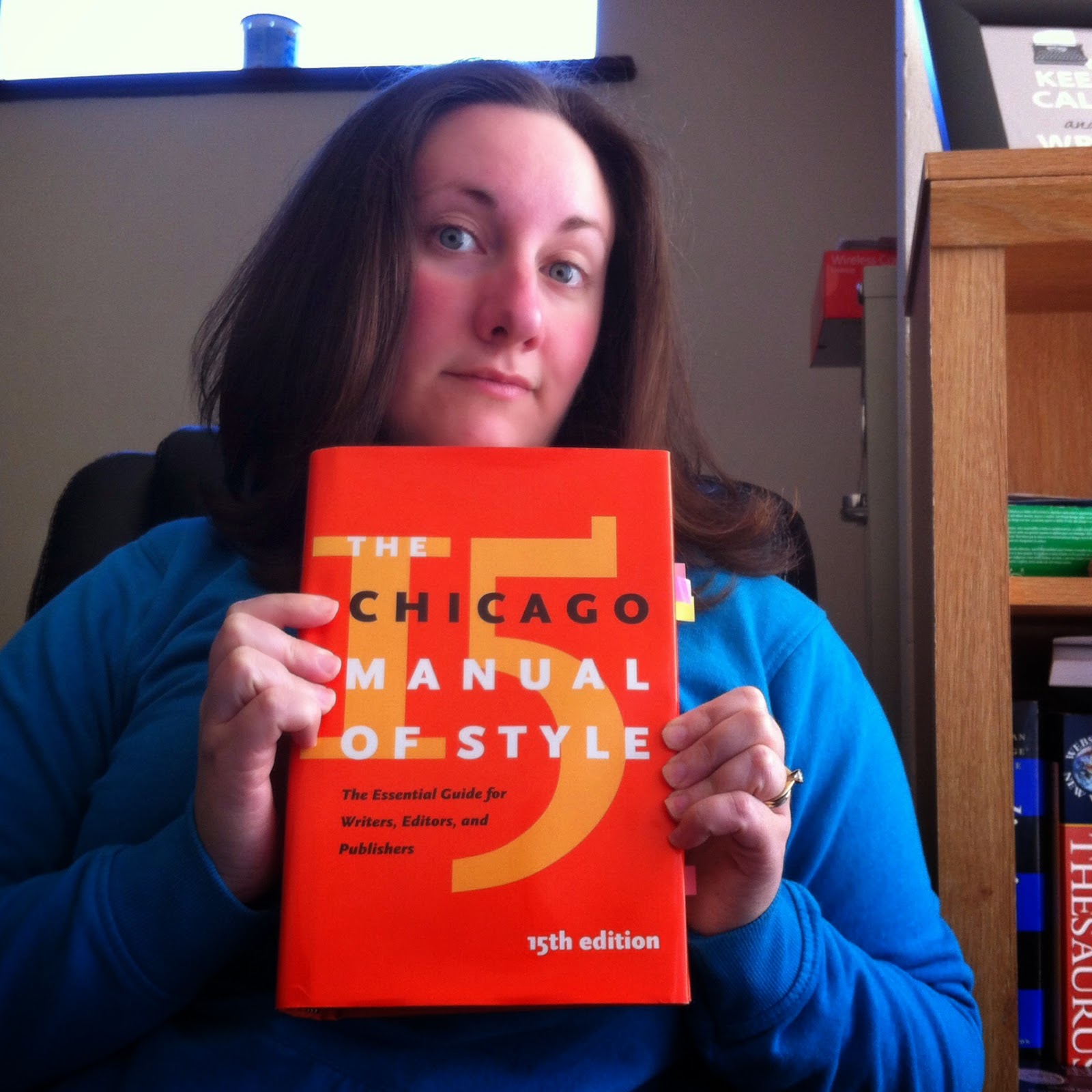
1) The Chicago Manual of Style, 15th Edition

Why do I look so "meh" in this picture? Because this book, while extremely comprehensive in terms of what it includes, extremely detailed, extremely large, and extremely useful, is also an extremely big pain in the ass.  Have I mentioned it's extreme?

If you don't know exactly where to look for the information you want, and it's not readily visible in the index at the back, finding what you want is a nightmare.  I often have to ask someone who has used it longer than I have where to find something in it--which often includes me asking them the question I was trying to find in the book in the first place because it's faster.  Then again, I have a bunch of lovely editor friends to irritate with these questions, so you may not have that luxury.  Also visible in the picture are some of the (many) sticky-note tabs I've marked pages and sections with so I don't have to go through the whole needle-in-a-haystack process again when I need the same info in the future.  If you buy this with other editing books, you'll get a lot of use out of it, though likely as a definitive answer for more obscure grammar rules.  Don't forget, I get paid to use this thing (this is the book the publisher I edit for uses as a reference), and my need for it will likely be greater than your average writer, though it might be worth a purchase anyway.

2) Painless Grammar by Rebecca Elliott, Ph.D.

I'm much more excited in this picture, and that's because this book is what most writers will need.  Most common grammar errors are addressed in easy to follow examples and situations...as the cover says, it's a "painless examination of parts of speech, sentence construction, and punctuation".  I reach for this one over the CMoS most times, though it's not quiiiiite comprehensive enough to be the only reference for someone who edits for a living, or for an author who wants to do a hardcore edit of their own work.  Again, I've sticky-note-tabbed some of my favorite breakdowns, including the explanation of "lay" and "lie" that I can never keep straight.

Plus, bonus points for the cat on the cover.


3) The Elements of Style (fourth edition) by William Strunk, Jr. and E.B. White

Yes, this E.B. White is the same guy that wrote Charlotte's Web, the book that reduced me to tears with every childhood re-read.  Thankfully, his and Strunk's writing style guide doesn't have the same reaction.

First of all, this book was recommended to me by Stephen King--sadly not personally, but through book #4 which I'll discuss in a bit.  If it was good enough for one of the most successful authors of modern times, it was good enough for me.  Strunk & White's book is short--the main part clocks in around 85 pages, not including the glossary at the end.  The breakdown includes Elementary Rules of Usage (including colons, dashes, apostrophes, etc.), Elementary Principles of Composition (including paragraphs, active voice, tenses, etc.), A Few Matters of Form, Words and Expressions Commonly Misused, An Approach to Style (including revising and rewriting, placing yourself in the background, not overwriting, over-explaining, or overstating, etc.), and the glossary at the back. There's a lot--and I mean a LOT--of direct, simple, straightforward information packed into this little book.  It's perfect for transporting, and, stacked up, about 6 or 7 will fit in my CMoS--I measured.

Again, this is the style guide Stephen King recommends, and with good reason.

4) On Writing by Stephen King

The book I'm enthusiastically pointing to is one of the best writing guides--which, oddly, isn't exactly that, nor is it a memoir or autobiography. The cover calls it "a memoir of the craft" and includes plenty of anecdotal stories by King about how he began writing in his youth, and the experiences that shaped his writing and his writing style.  But it's not all about him--he talks about what worked for him, and what doesn't or didn't, and doesn't bullshit or coddle the reader into thinking anything other than hard work and the labor of love will get you success...and maybe not even then.  I can't explain what exactly is so good about this book, but I couldn't put it down once I began reading it.  I can't recommend this book enough for any writer, no matter what genre.  Everyone will take away something different from this book.  Buy it...but finish reading this blog post first.

5) Indie Author Survival Guide by Susan Kaye Quinn

Sorry guys, no picture for this one. I have the ebook version, which I bought before it was available in paperback (which it currently is, though obviously the links within the book won't work in paper form unless you know something about books that I don't).

If you're even considering self-pubbing--maybe you're a beginning author and don't want a publisher; maybe you're a prolific author with a long back-list you've gotten the rights back to and want to self-pub; maybe you have a few traditionally published books but want to be well-rounded--whatever your reason, this book is a must-read for writers.

SKQ is a friend of mine (I guess you could call that a disclosure, though I'm certainly not receiving payment for this blog post or anything else), and she's been self-published before it was really a thing writers did. She's had a lot of time for trial and error, and has found things that have worked well for her and things that haven't, as well as things that did work but no longer do, and vice versa.  She addresses the changing face of self-pubbing and most every aspect you might, as a prospective self-publisher, have questions about.  SKQ has always been up front and eager to help writers, no matter what stage they're at, through her blog, and this book is an extremely organized (and updated) collection of her blog posts.

As I said, if self-publishing is even remotely on your radar, buy this. I've recommended it to many author-friends who have had nothing but good things to say about it.

That rounds up my favorite writing and editing guides (for now, at least)! Tell me in the comments what your favorite go-to reference is.  I'm always looking for new ones!

xoxo Sarah


Other posts in this series:

Part 1: Look it up!

Part 2:  Read it out loud.

Part 3:  Have someone who knows what they're doing read it.

Part 4:  Consistency, consistency, consistency!

Part 5:  Dialogue tag...you're NOT it!

Part 6: Pick the right word to say what you mean.

Part 7: Adverbs--Kill it with fire!

Part 8: Editors Aren't Perfect

Part 9: Frequently Seen Errors (FSEs)

Part 9.5: FSEs Pt.2

Tuesday, August 19, 2014

Interview Time with Susan Kaye Quinn!

Whoa, my friends are popping out books all over the place, and my friend Susan Kaye Quinn is a writing machine.  And if you read middle-grade books, have a middle-grade reader, or love books that are a little different, she's one you want to check out.  

Onward!

Hi, Susan!  I'd like to start with the most important question--I know we both share the love of a good cup of tea. What's your favorite? 

My current is Irish Breakfast, although I just came off a wicked bender of all forms of Chai (without milk – heresy, I know.)
Tell everyone about yourself and how you started writing...I smile every time I hear how you began. 

I’m an ex-rocket scientist and mom of three, who started writing fiction (seriously) about five years ago… and never looked back.

It's so cool that you're an actual rocket scientist!  And what are your favorite and least favorite parts about being a writer?

Favorite—creating something entirely new out of thin air. Least Favorite—not having enough hours in the day to write all the stories I want to.

If you had to narrow it down, what’s one piece of advice you’d give to other writers?

Write as much as you possibly can. Quality vs. quantity is a false choice: the more you write, the better you get.

I absolutely love that you’re so supportive and helpful to other writers, whether they’re just starting out or are seasoned veterans. I have to ask, what gave you the idea to blog about your experiences, and then use them to create the Indie Author Survival Guide (which, by the way, is amazing!)?

Thank you! Blogging about my experiences was second nature—writing stuff down helps me sort it out in my own head, and I figure if I’m struggling with something (or learning something new), it’s likely to help someone else. It took the urging of several friends over time to convince to put it in a book for sale… but I finally realized that I could actually help more people that way. That’s what sold me on pulling it all together and putting it on the largest ebook distribution system in the world (Amazon).

I’m actually thinking of pulling together a new book just before NaNoWriMo this year. It will draw from my micro-blogs, and act as a 30 day motivational text: one page a day to inspire your writing and keep your words flowing. We’ll see if I can get it together in time, but I think (hope?) it’s something people would find helpful.

That's an amazing idea! I'm all for that--sometimes I'll hit a rut and be unable to start up again as quickly as I'd like.  

Do you prefer silence or to have music on when you’re writing? What kind?

Silence. Unless I have to drown out my boys and their rambuctiousness during the summer.  :-) Then I listen to the soundtrack to Frozen.

How’d you get the idea for Second Daughter?

My editor for Third Daughter said, “Wait, that’s it?? You are writing another book in this series, right?”
I said, “Well, yeah, if I keep that ending. Or I could change it and end the book there.”
He said, “No, you need to turn it into a trilogy. And you should name them, Third Daughter, Second Daughter, First Daughter.”

No lie, that’s exactly how it went. So I brainstormed for an hour, found themes I wanted to write for Second Daughter, and wrote back to tell him that he’d have to edit two more books.

What a good, supportive editor! And how’s First Daughter coming along?

Sadly, I’m behind. My editor has most of the book, but I need to finish writing the ending. I’ll be doing that this week.

What are you working on now?

First Daughter, but as soon as that’s done, I’ll be on to starting the second season of Debt Collector. I need to remember next summer not to schedule vacations. They’re seriously interfering with my productivity!

Aw, a break can really rejuvenate the creativity, though!  

Tell us what genre(s) you write in, why, and what your experiences are like writing in Bollywood-steampunk for The Dharian Affairs trilogy?  How is the experience different from one to another?

I really write across a broad range of genres: YA SF, MG SF, steampunk romance, future-noir, non-fiction. The thing they all have in common is that they’re speculative fiction of one sort or another. I write a lot of different kinds of stories because I have a range of interests, but it does make marketing a tad more difficult. Basically, I’m starting over with each new genre. But I’m fine with that: I write the stories I love. It’s the great freedom of indie publishing.

Very true; you're not married to any type of "branding" that way. You have books out all over the spectrum—which one, or even which series, has been your favorite to write? Why?

My favorite is always the one I’m currently working on! :-) You have to be passionately in love with a story in order to do it justice. But I have to say, I’m eager to get back to writing my Singularity series, which hasn’t even been published yet. That one has seriously captured my heart.

What was your favorite scene to write in Second Daughter?

The kissing scenes (pretty much all of them) – I like the passion (and torment) that lead up to them, and if I do them right, they’re like a little reward for tension well-wrought. :-)

What scene gave you the most trouble in Second Daughter?

I would say the ending—I completely rewrote it in the second draft. Turns out the wrong character got shot the first time. :-) It was funny, because I knew something was wrong with it, but I couldn’t put my finger on it. My editor and my critique partners all thought it was fine. But as soon as I started writing First Daughter, I realized what was wrong and went back to rewrite it. That’s one reason I wrote these books (First and Second Daughter) so close together (overlapping really).

Where can we find you on the interwebs? 

https://twitter.com/susankayequinn

Where can we find your books?

If you subscribe to my newsletter, you can get a free short story!  http://bit.ly/SubscribeToSusansNewsletter

Blurb for Third Daughter: 
Third Daughter (Dharian Affairs#1)
Skyships, saber duels, and lots of royal intrigue... and, of course, kissing.

The Third Daughter of the Queen wants her birthday to arrive so she'll be free to marry for love, but rumors of a new flying weapon may force her to accept a barbarian prince's proposal for a peace-brokering marriage. Desperate to marry the charming courtesan she loves, Aniri agrees to the prince's proposal as a subterfuge in order to spy on him, find the weapon, and hopefully avoid both war and an arranged marriage to a man she does not love.

Third Daughter is the first book in the The Dharian Affairs Trilogy (Third Daughter, Second Daughter, First Daughter). This steampunk-goes-to-Bollywood (Bollypunk!) romance that takes place in an east-Indian-flavored alternate world filled with skyships, saber duels, and lots of royal intrigue. And, of course, kissing.


Thanks so much for stopping by, Susan!  

Have you or your kids read any of Susan's books?  Definitely check her work out because she writes for all ages. 

xoxo Sarah


Tuesday, January 7, 2014

Tips for Editing Your Manuscript from a Real-Life Editor, Part 1

In this new year, I'd like to do more to help my fellow writers.  I've always been inspired by the lovely Susan Kaye Quinn, who has always been so open to assisting other authors who ask for it.  She even compiled a new ebook that combines a series of blog entries (along with new material) to help folks make up their mind whether they want to self-publish or not, and how to do just that.

But what to help other authors with, exactly?  What skill set do I have that I can use for the greater good?

Well, I'm an editor.  A real-life professional one.  So we'll start there.  I'll give a few credentials to start...I'm contracted with a mid-size publisher to edit with them. I do free-lance editing, as well as critiquing in various forms for people.  I've also been part of a team that accepts/rejects online submissions to an online story archive.  So I've been editing in some form or another since 2008.  This ain't my first rodeo.

So, editing...  One of the hardest things to do is edit your own manuscript--or really your own work in general--because of author bias.  We (as authors) are naturally blind to certain things, and have read our own work over so many times that we don't even catch things like missing words.  Feel free to laugh...I've done that myself.  But we're obviously forced to do some editing before anyone who belongs to the publishing industry powers-that-be (an agent or acquisitions editor, for example) sees our work.  It needs to be in excellent shape to be considered for publication, though it is understood that it'll have to go through further editing during the publication process if it's lucky enough to get that far.  But you want to give your manuscript the best chance possible, right?

But then how do authors get their own work in shape to go out into the world? That's where I come in.  These tips are in no particular order, and are a guide to those of you who want to do a good job at self-editing (and good editing ideas in general) before you start querying or officially self-publish your book on Amazon or Smashwords or wherever you're doing it.  Especially with self-publishing, a quality product will translate into higher sales.  Readers have high standards, so strive to meet them.

I'm even going to split this into multiple parts, because I got a bit carried away and this entry became far more detailed than I'd expected.

So onward to the first point...

1)  Look it up.

This may seem intuitive, but we all make common writing errors.  All of us.  No one is immune.  Let me repeat that: NO ONE IS IMMUNE, even you, Super Writer.  So if you're using one of the many commonly misused words, or like to use (or abuse) semi-colons, look it up to make sure you're using them correctly, even if you're pretty sure you are.

Where do I find this information?  Well, when I edit, I reference the incredibly clunky Chicago Manual of Style.  But it's not user-friendly, even for those of us who know what section we're looking for.  Honestly, for most grammar issues, I use Painless Grammar.  The examples in it are easy to understand, and none of it is overly complicated.  However, there are countless grammar books like that one, so find one that works best for you.  And there's always Google, though I'd be more careful with that, unless you're one of those people who trusts everything they read on the interwebs.

"But," you may ask, "don't most manuscripts you see already have this kind of stuff ironed out?"  Well, no.  They don't.  And sometimes I want to put the Cone of Shame on an author.

When I edit a manuscript and return the work to the author, I always include a list of repeated issues I've come across.  By that point I've spent hours--sometimes it cumulatively adds up to days--reading their work over and over, and I feel it's partly my job to point these things out because it can help the author learn and they'll be less likely to repeat these things in future manuscripts.  It makes less work for me (or whoever the editor is who's editing their new work) and the author learns something valuable.  It's a win/win.  In one recent manuscript I had, the author constantly confused further/farther, and I had to do a global search in the document for both words to make sure the correct one was used (or fix it if it was incorrect).  So I made sure to let her know about that when I returned it to her.  This is something that would have easily been fixed by the author taking a few minutes to check which word would have been appropriate.

And before you ask, yes, I do it too. Even with as long as I've been editing, one thing that still trips me up is affect/effect and every damn time I write one of them I have to make sure I'm using the correct one.

What's your favorite reference to use when writing?  Internet?  A particular book?

Point #2 is coming up shortly, so stay tuned!

xoxo Sarah

Sunday, October 6, 2013

Indie Author Survival Guide


For my first guest post, here's one from Susan Kaye Quinn, a successful self-published author who I've known for quite a while now.  She was so amazingly helpful to newbie authors, including many a detailed blog post, and she created this book so everyone can educate themselves.  

This book is for every author who's thinking about indie publishing, or has already taken the leap, and wonders why no one told them about the sharks, the life-sucking social media quicksand, or the best way to avoid sales-checking, yellow-spotted fever. This is a guide for the heart as much as the head. And because I promised myself that I wouldn't write a book about how I made a gazillion dollars publishing ebooks, I would write about the fear: owning it, overcoming it, facing it. From a person who didn't pursue a creative life for a long time, and then discovered creativity can set you free. Note: gazillion is a technical term, which in this case means something less than a million and more than the average income in my state.
Susan Kaye Quinn is the author of the bestselling Mindajck Trilogy and Debt Collector serial and has been indie publishing since 2011. She’s not an indie rockstar or a breakout success: she’s one of thousands of solidly midlist indie authors making a living with their works. This book is a compilation of her four years of blogging through changes in the publishing industry—updated, revised, and supplemented to be relevant in 2013. It’s a guide to help her writer-friends take their own leaps into the wild (and wonderful) world of indie publishing... and not only survive, but thrive. You can friend her on Facebook or follow her on twitter or check out her blog where she'll be doing who knows what next.
Grab the Badge for your blog!
Sign up for bookmarks!
Win the t-shirt!
FAQ About the Guide
Q: What prompted you to write the Guide? I resisted a long time in putting this together. I had this silly idea I was a fiction writer (which is also true), in spite of spending the last four years blogging consistently about the industry, and especially the changes wrought by indie publishing. It took the goading of several friends, over a period of time, before I realized that the blog was actually non-fiction writing (I can be excessively slow for Ph.D. engineer sometimes). The trigger for blogging the book - revising and updating old posts as well as organizing the content - was seeing writer friend after writer friend take the leap, often after reading something I had posted. And I realized there wasn't a book out there that addressed the fears as well as the nuts-and-bolts about going indie. I could have just left the Guide on my rinky-dink blog, but I knew the power of Amazon (and other retailers) to connect people to books, and I figured it would help more people this way. Q: Why should I read a book about indie publishing by Susan Kaye Quinn? I'm pretty sure she's not a NY Times Bestseller. I'm not an indie rockstar. I haven't made the news as one of those "exceptional" breakout indie authors. I'm a solidly midlist indie author, which means I make a living off my works. I'm one of thousands of invisible indie midlist authors who, I believe, are the core of indie publishing, and why it's changing the industry. The rockstars of indie publishing can inspire and lead, they can use their leverage to break barriers, but they can't transform the industry on their own. The true change has to come, as it always has, from the grass-roots. I'm part of that grass-roots movement. Q: Will this Guide help me get rich quick from ebooks? No. Q: Will this Guide help me decide if indie publishing is right for me? Yes. Q: What if I'm afraid? We're all afraid. Fear is an integral part of being vulnerable in the world by daring to do brave things. Fear stops many people from becoming the full expression of who they are. I won't tell you not to be afraid in this book - I'll help you see the fear for what it is, manage it, and not let it stop you from reaching for the amazing things you have ahead of you. Q: What if I don't have the first clue how to start with self-publishing? The Guide is designed to take a first-time-publishing author from the decision to go indie through to writing that second book (and starting the whole process over again). It's also designed to help indie authors who have already published, but are struggling: either with keeping perspective for the long-term, trying to scale up their businesses from the first book, or just trying not to drown in social media quicksand. My hope is that all my indie author friends will find something worthwhile in it, or pass it on to someone who will. The culture in indie publishing of sharing information is part of what inspired this book in the first place.