Showing posts with label craft. Show all posts

Monday, December 15, 2014

Tips for Editing Your Manuscript from a Real-Life Editor, Part 8

Part 1: Look it up!

Part 2:  Read it out loud.

Part 3:  Have someone who knows what they're doing read it.

Part 4:  Consistency, consistency, consistency!

Part 5:  Dialogue tag...you're NOT it!

Part 6: Pick the right word to say what you mean.

Part 7: Adverbs--Kill it with fire!


Welcome to Part 8: Editors Aren't Perfect.


I'm often asked whether anything trips me up as an editor. And the answer is, unequivocally, YES. There are just some things that, even after repeated hammerings-in, just don't make it into my thick scull.

I'm not afraid to admit that I don't know everything related to writing, but that's why I own copies of several different editing and/or style guides.

But what stumps me? What's bookmarked and dog-eared in my editing reference books?

I'll tell you.

Keep in mind that these are just a few things, and, for the sake of brevity, I'm not going to go into detail on the correct meanings or usage of them--feel free to look those up, though I might stick a link or two in there if I feel like it.

Lie and Lay  

For the life of me, I can't keep this one straight, especially since the different tenses of the different words are often the same or cross-overs. This has to be one of the most-visited section of my editing guides, particularly because I have to look up the proper usage each time one of these (or a tense) is used.

Affect and Effect

Ugh. This one. Every time I use one in my own writing, even a freakin' Facebook post, I have to look it up. Drives me crazy that I can't keep this straight.

Time Format

Should it be AM/PM? a.m./p.m.? am/pm? Where does it go in relation to the actual numerals? This one is a frequently visited page when it comes up, which, thankfully, isn't often.

Colons and Semi-Colons

I've been told before that I sometimes misuse semi-colons, and I'd rather not use them at all than use them incorrectly. Colons are used so infrequently (unless it's with time) that when I see one used with a list or something else, it's an automatic look-up. Personally, I'm not a fan.

Em Dashes 

Usually these don't bother me and are more of a stylistic thing I rather like using in my own work, but they sometimes trip me up when wondering where to place them in dialogue that has been interrupted by something, typically a character's action.  Though, oddly enough, it makes a difference whether the dialogue stops completely for the action to take place, or whether the dialogue continues on, and the interruption is more of a note for the reader. Complicated? Not really. Hard to keep straight? Yep.

Example showing more of a "dialogue note" interruption, straight out of my CMoS 15 that I consult regularly: "Someday he's going to hit one of those long shots, and"--his voice turned huffy--"I won't be there to see it."  Blogger is weird and won't let me use a proper em dash, but the little hyphens there are the same thing.


This obviously isn't a comprehensive list, but there you have it!

What grammar/spelling/punctuation thing leaves you stumped every time?

xoxo Sarah


Thursday, October 2, 2014

Tips for Editing Your Manuscript from a Real-Life Editor, Part 7

Part 1: Look it up!

Part 2:  Read it out loud.

Part 3:  Have someone who knows what they're doing read it.

Part 4:  Consistency, consistency, consistency!

Part 5:  Dialogue tag...you're NOT it!

Part 6: Pick the right word to say what you mean.

This is part 7: Adverbs--Kill it with fire! 

Or, as Stephen King says in On Writing: "The road to hell is paved with adverbs."

Apply adverbs here...

That might sound like a little extreme, but trust me, adverbs are not your friend. What's an adverb? It's basically the equivalent of what an adjective is to a noun, but it's a word that describes or modifies another adverb, adjective or, most commonly, a verb--how something is done. Often--but not always--they end in "ly".

He walked slowly.  How did he walk? Slowly.

She talked quietly.  How did she talk? Quietly.

You get the idea.

So what's the problem with adverbs? Description is good, right? And I'm always on everyone about showing, not telling (*maniacal laughter* You just wait...there'll be an entry in this series on that too, I can guarantee it).

The problem with adverbs is that there's almost always a better word to use that makes your narrative stronger. See all those words in bold and italics? I even went overboard with the emphasis so you guys would know I'm serious.

And since I'm so big on showing, not telling, I'm gonna show you.  Read the following two narrative paragraphs, and pick the stronger one...

Kylie quietly walked through the house. She'd waited patiently all day for her family to leave. Now, Kylie finally had the computer all to herself. She firmly pressed the button and switched it on, fidgeting excitedly as it slowly booted. The web browser opened suddenly, and Kylie meticulously poked in the address. Yay! Kylie thought happily. Now I can immediately watch my favorite cat videos!

Kylie tip-toed through the house. She'd waited all day for her family to leave. Now, Kylie had the computer all to herself. She pressed the button and switched it on, fidgeting as it booted. The web browser opened, and Kylie poked in the address. Yay! Kylie thought. Now I can watch my favorite cat videos!

The second one is stronger, more direct, and clearer, and that's with only changing one of the adverbs (quietly walked to tip-toed) and just deleting the others. Even better would be to find ways of showing even more using other, stronger, words.

Here's what I mean by that:

Said quietly becomes whispered.

Walked slowly becomes strolled.

By using a single word (or a short phrase) in place of the adverb, it provides a more direct description of what's happening and makes it clearer to the reader.

This post with a giant quote from Stephen King's On Writing, where he talks dandelions in your word-garden and closing the door firmly, takes the cake. Go read it. I'll be watching Nyan Cat until you're done...


...

Back already? Good.

Oh, and like the awesome Mr. King says, for the love of Jesus on a Velociraptor, please don't use them with dialogue tags. For 99% of the time, let the dialogue communicate how someone says something. For the other 1%...well, I guess I can let it slide.

"Fine, Mom, but as soon as I'm done cleaning my room, I'm gonna watch cat videos again," Kylie said dully.

See what I did there? I crossed out the adverb. Why? Because you don't need it. It's clear from the dialogue that Kylie is whining (you could, in theory, use "whined" as the dialogue tag instead of "said", but, again, it's not necessary--her tone is already clear to the reader, and readers aren't stupid).

There are ways around using them, too. Is it recommended? Well, that probably depends on what you're trying to accomplish with the description...

"Of course you'd want to watch cat videos instead of eating pizza with me," Jen said scathingly.

"Of course you'd want to watch cat videos instead of eating pizza with me," Jen snapped.

Is it easy to tell from the dialogue that the words are said "scathingly"? Maybe, maybe not. But in cases like this, it'd be your call whether to use an adverb or not. Better yet, change "said" to "snapped" or something like I did. It's not one of those dialogue tags that's too "out there", and it effectively communicates what you're trying to get across about how Jen is saying something.

Let me also say that I'm a huge fan of adverbs...in a first draft. Mine are littered with them. But, because this is an editing how-to tip post thingy, I feel I should emphasize that I try my best to catch them and weed them out (haha, get it? Weed them out? Like dandelions? You'd get it if you read the Stephen King bit above...), replacing the adverbs with stronger language or taking them out completely. So feel free to let your first-draft garden get a bit overgrown...you'll be taking some Round-Up to it when the second draft comes along.

Are you guys finding these posts useful? What are your thoughts on adverbs? Please let me know in the comments. :-)

xoxo Sarah


Monday, July 21, 2014

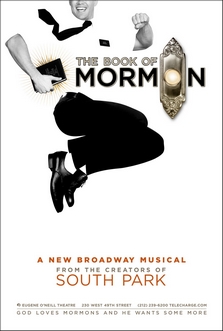
Awesome Writing in Media, Part 4: Book of Mormon

In Part 1 and Part 2 of this series, I talked a bit about two notable writers from the television and movie worlds: Joss Whedon and Quentin Tarantino.  And in Part 3, I diverted a bit to discuss the movie Horrible Bosses.  Providing you haven't thrown your hands up in despair for my taste in awesome writing in media, here's another one for you.

Here in Part 4, I'm taking another turn, this time in to the world of theater.  My husband and I have been very lucky to enjoy quite a few stage productions over the years (though we'd always be happy to see more of them), and, like movies, the hype is often built up so much about one that you're left feeling wanting and let down after seeing it.

I'm happy to report that this was not the case with Book of Mormon.  It's a freaking 9-Tony-award-winning musical that's both a satire and comedy, written by the team of Trey Parker and Matt Stone (the creators of South Park) and Robert Lopez, who apparently worked on the writing for Avenue Q before that, at least according to Wikipedia.  And that, ten years ago, was a sentence I never thought I'd write.


I should mention that if you're of the easily-offended variety, be it about religion or lady-parts, you'll probably want to stop reading here.  Thanks for stopping by, and avoid this play like the plague.

Everyone good now?  Awesome.

The premise is that two young, naive Mormon missionaries are assigned to a remote village in Africa to bring the Book of Mormon--the sacred text of the Latter Day Saints--to the people there and baptize them into their faith. Unfortunately, the missionaries have difficulty connecting with most of the locals, who are ruled by an evil warlord obsessed with female circumcision.  I don't want to give any more away than that, because this is just something you have to see for yourself.

The plot and characterization are unmistakably Parker and Stone; the whole play seems as though it's a live-action version of the best South Park episode you've ever seen (minus the core characters, obviously).  The Mormon missionaries, villagers, and the rest of the cast are full of caricature and satire, overdone in the best possible way.  Even the social commentary is spot-on and universal; when I saw the play, it was in London at a West-end theater, and I think the audience mostly consisted of British people--everyone loved it, and everything translated just fine. If anything, they thought it was funnier, because they got to poke fun at Americans.

As for the music and lyrics, those fit in with the plot and dialogue and never felt out of place.  Whether the characters are singing a cheerful song which title translates to "Fuck you, God!", or one about repressing negative thoughts or homosexual feelings, it all works.  And by works, I mean has you laughing your ass off.

But, Sarah, you may be thinking.  You can't possibly lump this play in with the likes of Phantom of the Opera, or Les Miserables, or any other amazingly popular musical?

No, you can't.  They're apples and oranges and pomegranates; you can certainly be fans all of them, but Book of Mormon is fresh and interesting, and an entirely different fruit altogether.  Plus, Phantom doesn't have a spooky dream sequence in Hell, and Les Mis seems to be missing some crossover references with The Hobbit, Star Trek, and Star Wars.

One caveat is that I think Book of Mormon is probably geared toward a younger audience (40 and under, I'd guess) or those of any age who aren't easily offended.  My parents enjoyed every minute of it when we took them.  Good writing is universal, so go see it in London or on Broadway, or even one of the touring companies if you can.  I don't think you'll be disappointed.  Just don't wait; it often books out months in advance.

Have you seen it?  What did you think?

xoxo Sarah


Monday, July 14, 2014

Awesome Writing in Media, Part 3: Horrible Bosses

Okay, bear with me on this one.  I've decided to jump around a bit and will, instead of solely focusing on individual writers in this series, also focus on works as a whole.

Also, just so you don't feel obligated to stop reading, I won't spoil any of the movies or other media for you. Promise. Or, at least I'll try not to.

Hopefully none of these, so rest easy.
That doesn't mean I won't talk about the plots or characters, but I'll try not to give something away that would ruin the movie(s) for people.  On the other hand, if there's a movie (or its source material, if it was based on a book) that's been out for a long time, all bets are off.  People whining about Martin Freeman "spoiling" something in one of the Hobbit movies are ridiculous...that plot point has been out for seventy-something years.  Suck it up, buttercup.

Anyway, onward!


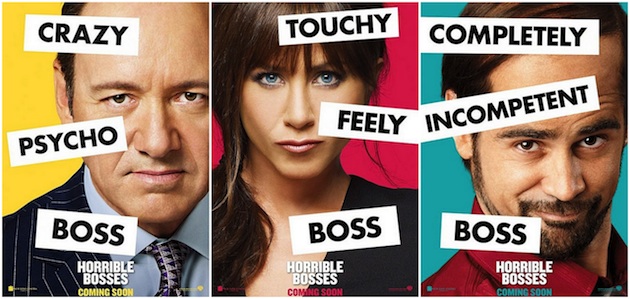
Honestly, Horrible Bosses wasn't a movie I initially had high hopes for.  Sure, I knew it would be entertaining--the cast includes Jason Bateman, Jennifer Aniston, and Charlie Day among other notables--so when it came out and we got it on Netflix, I was looking forward to seeing it, but was expecting your standard comedy.

How wrong I was.

Now, this post, as are all of the posts in this series, is just my opinion, but I enjoyed Horrible Bosses far more than I thought I would, and that was due just as much to the amazing writing as to the great performances by the cast.  Was it a perfect movie?  No, of course not, but it was a smart, well-written  comedy.  And in the current movie climate, that is a rare thing indeed.

What was so good about it?  The cast, for one, deserves a lot of credit for their kick-ass performances, but the writers made it all happen.  The premise of the movie is that three guys each have a boss that makes their lives absolutely miserable--so they figure out that they'd be so much better off if the bosses weren't around anymore (in the dead sense).  See, it would have been so easy for the writers to phone in a script where the characters were flat and boring and made the illogical--and extreme--jump to murder to get their lives back.  But it's far more than a case of "Ugh, my boss is annoying." "So is mine!"  "And mine!" "Let's murder them!"  One of the main things that stands out about the script is how well-rounded and justified the characters are.  Each one of them--the bosses and our heroes--are shown in the beginning of the movie so we see exactly how each of the characters' lives are impacted by their, well, horrible bosses.  These hard-working folks are being slowly driven crazy by these people, and we, the audience, buys it hook, line, and sinker.

I like to say that with writing--any kind of writing--the audience or reader needs to identify with the characters or believe the story they're reading or watching could happen, even a little itty bitty bit.  Sci-fi, comedy, romance, action--doesn't matter.  If the audience doesn't buy into it, your movie or book is dead in the water.  And even though each of the bosses in this movie are caricatures, between the three there will be a tiiiiiiny bit of a supervisor you, the viewer, have had at one time, and that's enough.  You're in and along for the ride. 

Oddly, nothing feels forced about the movie.  Sure, some of the scenarios are ridiculous, but it's a comedy, and my suspension of disbelief never felt like it was about to snap.  The way everything ties together at the end is satisfying and, again, that's credit to the writers.

Will all of this hold true for the sequel?  I have no idea; it's a rare sequel that can recapture the magic of the original.  I guess we'll have to find out.  In the meantime, if you're looking for a fun, well-written comedy, check out Horrible Bosses.

Have you seen it?  What did you think?  Was the writing above-average for a comedy nowadays?  Have you seen one that you thought was far better?  Tell me!

xoxo Sarah


Monday, July 7, 2014

Awesome Writing in Media, Part 2 : Quentin Tarantino

Back in Part 1 of this series on awesome writing in media, I discussed my love for Joss Whedon.

But this time around, I wanted to talk about someone a little more polarizing...Quentin Tarantino.  The more I talk to people about him and his movies (which include Pulp Fiction, Django Unchained, Inglourious Basterds, among others), the more I'm convinced that you either love him or hate him.

Most of the movies Tarantino has made he's both written and directed, and has taken home and/or been nominated for quite a few awards for his work.  Like him or not, he's a talented guy.  And I happen to enjoy his movies.

Why?  Because they're different.  There's this odd mix of extreme, bloody violence, unique plots, and interesting dialogue--complete with gratuitous swearing.  Tarantino makes movies that aren't formulaic; he makes the movie he wants to make, and because he has his hands in so many aspects of the movie-pies, he has a lot of creative control to do just that.

So, what about these movies do I enjoy so much, exactly?  As with Whedon, Tarantino has a knack for dialogue, but not in the same way.  While Whedon's is quick-witted and sharp, Tarantino's dialogue is real.  His characters have long, odd conversations, and they do it in way that makes you think you're eavesdropping on real people.

Here are two examples that always stick out in my head when I talk about his dialogue writing style (which, oddly, happens more than you'd think).  The first one is from Pulp Fiction, and is a conversation mostly between John Travolta's Vincent Vega and Uma Thurman's Mia Wallace.  Vincent has been charged by Mia's husband, Marsellus Wallace, to take Mia out for the evening to make sure she has fun while Marsellus is away.  They go to a restaurant called Jack Rabbit Slim's, where she orders the famous Five Dollar Milkshake and later enter a dance contest.  Their conversation in this scene isn't really related to the rest of the movie, but somehow fits anyway.  Check it out below... (language is NSFW)


The other scene that stands out in my head is from Reservoir Dogs during which the characters discuss tipping.  The cast is quite big in this movie, but for the clip below to make sense, the only thing you need to know is that the group of men here are a bunch of criminals--which makes the scene even better.  Again, like the milkshake scene above, their conversation has no real relevance to the rest of the movie, though it gives the viewer a sideways look at their characters and their personalities.  A perfect example of what I try to drive home to the lovely authors I work with: show, don't tell.  As with the other video, the one below has plenty of NSFW language...


There's something about a scene where a group of criminals argue over tipping, including defending the hard-working waitress.

Along with Tarantino's unusual style of dialogue go his unique stories and plots.

Want to hear a story about a female assassin who wakes from a long coma, only to discover that the child she'd been carrying has been taken from her womb and that she needs to exact vengeance upon the ones who wronged her?  Yup, got you covered.

Want to watch a WWII movie about Jewish U.S. soldiers who conspire to assassinate Nazi officials, including Hitler?  Check!

How about a story about a freed slave who, with the help of a German bounty hunter, is on a mission to rescue his wife from a plantation owner?  Sign me up!

He weaves tales about characters from all walks of life, even rewriting history in Inglourious Basterds and Django Unchained.  Some even theorize that all of his movies take place within the same insane universe.  Personally, I think that's very plausible.


And it would take a good storyteller to be able to weave that kind of thing together over so many years.  For reals.

I also give Tarantino a lot of credit for his story and directorial quirks...  Things like his distaste for brand names, so he makes up his own products (Red Apple cigarettes and Big Kahuna burger are just two) and uses those instead of product placement.  That allows the viewer to concentrate more on the story than on the overly-commercialized movie they're watching.  Okay, that might be a bit of an exaggeration, but everyone can think of at least one movie or television show where you begin to roll your eyes at all the product placement.

Most of the points in this post are just my opinions; plenty of people can't stand Tarantino's movies for the exact reasons I've listed that I enjoy them.  They're too out there; too violent; too meandering in their conversations.  And that's okay.  They're not for everyone.

How about you?  Are you a Tarantino fan or not?  Do you only like some of his movies?  Do you have a favorite or one you particularly can't stand?

xoxo Sarah


Tuesday, June 24, 2014

Awesome Writing in Media, Part 1: Joss Whedon

So I've been in my little writer/editor cave for the past few months, working my little writer/editor butt off on various projects.  The problem with that (besides neglecting this blog, which I clearly maintain with the sporadic manic-ness of a coke-addict), is that my poor husband gets neglected as well.

Quality time is at a premium, you know.

So, like many busy couples nowadays, we have to make the effort to spend time together.  Our "thing", ever since we started dating, was to watch movies together, which then spread into shared television shows.  And with the plethora--jeez, I've been hitting the thesaurus too hard--of media out there, we've found that we need to minimize our watching in order to maximize our time and enjoyment, if that makes sense.  

Let me back up a bit so this makes more sense.  I've never been much of a comic reader, but many of the movies he's dragged me to (the dragging was what happened initially; I went willingly after I realized I enjoyed them) were comic book movies, the Marvel ones in particular.  

A couple of years ago, one of their movies was in production--a little picture called Avengers, or Avengers Assemble if you're over here in the land of tea and scones.  You may have heard of it.  Anyway, at the time, I kept reading online that some guy named Joss Whedon was going to be writing and directing it.  And amid everyone else's flailing and fangirling and fanboying, I was all, "Sooooo... I guess this guy's written some stuff before this, yeah?" 

To which I'd get this reaction: 


And then I'd be all, "What? What'd I say? Why do you all suddenly have pitchforks and other pointy objects?"

Because at that point, I'd never seen anything he'd done before. Yep. I was that person. You can stop hating me now, though, so put down the stabby things--I'm totally on the Joss Whedon bandwagon.  

While the other Marvel movies were good, Avengers was, well, kind of in a class of its own.  Even though he was juggling multiple characters who had (mostly) each had their own movies already, the writing was tight, the characterization was taken to another level, and it all just seemed to work.  I can't even explain it.  Maybe it was magic.  I couldn't stop smiling for days after seeing that movie, so naturally we went and saw it again.

After that, I asked my husband if we could work our way through Firefly.  I'd tried to watch it before on a friend's recommendation--and I'd hated it.  I have no idea why; just something about the first episode or two didn't resonate with me, so I gave up.  But this time around I told myself that even if it wasn't my cup of tea, it was only on for, well, less than a season (sorry for poking a sore spot, Firefly super-fans), and I could suck it up and watch it all.  We did, and I immediately wanted to set fire to Fox studios for cancelling it.  *NOTE* For legal reasons, I feel I should say I was just speaking in metaphor--I'm not going to burn any television studios (or any building, for that matter) to the ground.  It seems like a lot of work, for one, besides being highly illegal.  **Edited Note** Unless there are spiders. Then all bets are off...

So we decided to tackle another of Joss Whedon's works, this time, the ultimate one, according to fans: Buffy the Vampire Slayer.  A quick note: Joss Whedon worked on the movie of the same name, but his script went through re-writes by other writers to make it more...well...what it was.  The show isn't particularly related to it, if at all.  

We're currently getting ready to start season 3 of Buffy, and consequently, season 1 of Angel.  We've been told by fans to watch these concurrently, because they aired back-to-back, so that's what we'll be doing.  Also, my husband and I went to high school around the time Buffy aired--she and her friends were going through high school at nearly the same time we had, so there's this weird sense of nostalgia while watching the show.  I'm pretty sure I owned most of Willow's sweaters.

Anyway, I suppose I should mention why I enjoy Joss Whedon's work, as opposed to just taking a whole blog post and fangirling to my little heart's content.  

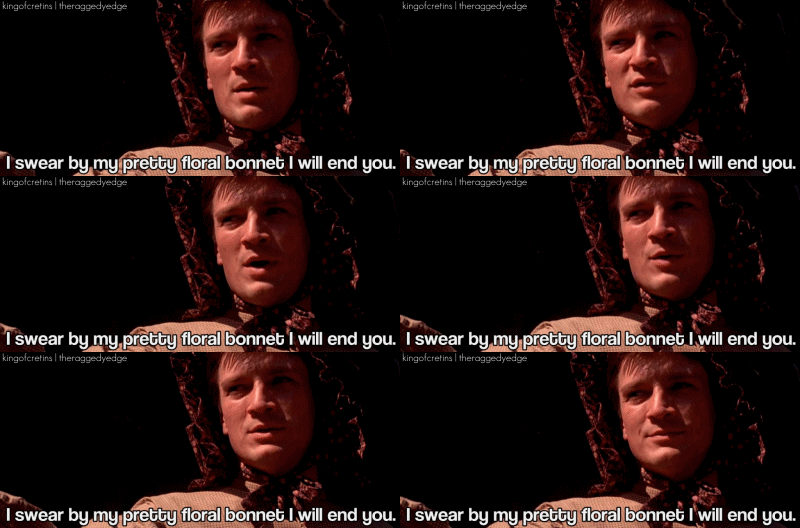
He "gets" characterization, for one.  They're not all good or bad, not black or white, but delightfully flawed shades of gray.  Loki, the main nemesis in Avengers, has moments of real sympathy (and it's not all because Tom Hiddleston is ridiculously hot) because of the writing.  Captain "Mal" Reynolds of Firefly, played by Nathan Fillion, can be pretty heartless--as the captain of a ship that primarily smuggles goods and often deals with unsavory characters, he has to be--but he has so many redeeming qualities that the viewer sees him as a well-rounded person, not just a flat character.  Buffy isn't just a ditzy blonde mess who simply stabs things that go bump in the night; she's a teenager with teenager problems and teenager concerns.  One of my husband's favorite characters on Buffy is Cordelia Chase (played by Charisma Carpenter).  She's a vapid, rich, daddy's girl, but there's something endearing and oddly sincere about her, what she says, and how she interacts with the other characters.  She's far from one dimensional--though she easily could have come across that way in the wrong hands--and is a valuable part of the show.

Dialogue is another of Whedon's strong points.  All throughout his work (so far), I've noticed that the conversations between characters are snappy and real.  Are people that clever in real life conversations?  Some are--I've met some--but most aren't, and that's what makes Whedon's dialogue enjoyable to listen to.  Upon watching Buffy, I can often hear in Xander Harris (Buffy's friend played by Nicholas Brendon) some of Tony Stark's snarkiness that would later appear in Avengers. Was Tony snarky in the Iron Man movies before Avengers? You betcha. But he was extra-cleverly snarky in Avengers. My blog, my analysis. So there.

Because of Whedon's strong writing, the shows are smart.  There have been multiple times when we've been watching Buffy and something about the episode occurs to us that hasn't appeared to have caught the notice of the characters, and a few seconds later they acknowledge it.  Example:  On Buffy, Cordelia catches the eye of the new Watcher (the person in charge of research, training the Slayer, and keeping them informed), Wesley.  They're clearly attracted to each other, though Wesley is probably in his twenties, and Cordelia is a high school senior.  My husband turns to me and asks, "But she's eighteen, and he's not even a teacher there! There shouldn't be any problem with them even dating if they wanted to.  What's the deal?" Literally a minute later while we're watching a scene at the prom, Giles, the school librarian and Buffy's previous Watcher, tells Wesley to just ask Cordelia to dance because she's eighteen, and he has the "emotional maturity of a blueberry scone."  See, most shows just drag out drama like that for no reason, almost like the characters are too obtuse to realize that they're making things more difficult for themselves and each other.  However, the viewer gets the sense that Whedon respects the viewer and their intelligence; that he believes we deserve better.

What's your favorite Whedon show or movie?  Thoughts on what I've discussed above?

xoxo Sarah


Tuesday, January 7, 2014

Tips for Editing Your Manuscript from a Real-Life Editor, Part 1

In this new year, I'd like to do more to help my fellow writers.  I've always been inspired by the lovely Susan Kaye Quinn, who has always been so open to assisting other authors who ask for it.  She even compiled a new ebook that combines a series of blog entries (along with new material) to help folks make up their mind whether they want to self-publish or not, and how to do just that.

But what to help other authors with, exactly?  What skill set do I have that I can use for the greater good?

Well, I'm an editor.  A real-life professional one.  So we'll start there.  I'll give a few credentials to start...I'm contracted with a mid-size publisher to edit with them. I do free-lance editing, as well as critiquing in various forms for people.  I've also been part of a team that accepts/rejects online submissions to an online story archive.  So I've been editing in some form or another since 2008.  This ain't my first rodeo.

So, editing...  One of the hardest things to do is edit your own manuscript--or really your own work in general--because of author bias.  We (as authors) are naturally blind to certain things, and have read our own work over so many times that we don't even catch things like missing words.  Feel free to laugh...I've done that myself.  But we're obviously forced to do some editing before anyone who belongs to the publishing industry powers-that-be (an agent or acquisitions editor, for example) sees our work.  It needs to be in excellent shape to be considered for publication, though it is understood that it'll have to go through further editing during the publication process if it's lucky enough to get that far.  But you want to give your manuscript the best chance possible, right?

But then how do authors get their own work in shape to go out into the world? That's where I come in.  These tips are in no particular order, and are a guide to those of you who want to do a good job at self-editing (and good editing ideas in general) before you start querying or officially self-publish your book on Amazon or Smashwords or wherever you're doing it.  Especially with self-publishing, a quality product will translate into higher sales.  Readers have high standards, so strive to meet them.

I'm even going to split this into multiple parts, because I got a bit carried away and this entry became far more detailed than I'd expected.

So onward to the first point...

1)  Look it up.

This may seem intuitive, but we all make common writing errors.  All of us.  No one is immune.  Let me repeat that: NO ONE IS IMMUNE, even you, Super Writer.  So if you're using one of the many commonly misused words, or like to use (or abuse) semi-colons, look it up to make sure you're using them correctly, even if you're pretty sure you are.

Where do I find this information?  Well, when I edit, I reference the incredibly clunky Chicago Manual of Style.  But it's not user-friendly, even for those of us who know what section we're looking for.  Honestly, for most grammar issues, I use Painless Grammar.  The examples in it are easy to understand, and none of it is overly complicated.  However, there are countless grammar books like that one, so find one that works best for you.  And there's always Google, though I'd be more careful with that, unless you're one of those people who trusts everything they read on the interwebs.

"But," you may ask, "don't most manuscripts you see already have this kind of stuff ironed out?"  Well, no.  They don't.  And sometimes I want to put the Cone of Shame on an author.

When I edit a manuscript and return the work to the author, I always include a list of repeated issues I've come across.  By that point I've spent hours--sometimes it cumulatively adds up to days--reading their work over and over, and I feel it's partly my job to point these things out because it can help the author learn and they'll be less likely to repeat these things in future manuscripts.  It makes less work for me (or whoever the editor is who's editing their new work) and the author learns something valuable.  It's a win/win.  In one recent manuscript I had, the author constantly confused further/farther, and I had to do a global search in the document for both words to make sure the correct one was used (or fix it if it was incorrect).  So I made sure to let her know about that when I returned it to her.  This is something that would have easily been fixed by the author taking a few minutes to check which word would have been appropriate.

And before you ask, yes, I do it too. Even with as long as I've been editing, one thing that still trips me up is affect/effect and every damn time I write one of them I have to make sure I'm using the correct one.

What's your favorite reference to use when writing?  Internet?  A particular book?

Point #2 is coming up shortly, so stay tuned!

xoxo Sarah

Wednesday, July 17, 2013

Oh, the Angst!


Sometimes--for me, anyway--emotions can get in the way of writing.  Ever try to bang out a couple thousand words of a fight scene but you're in a sparkly-unicorn-farts good mood?  Or attempt to write a chapter of happiness, only to discover that the funk you're in makes this next-to-impossible? 

This usually happens to me when the moods are extreme, but I have a feeling we've all been there.  

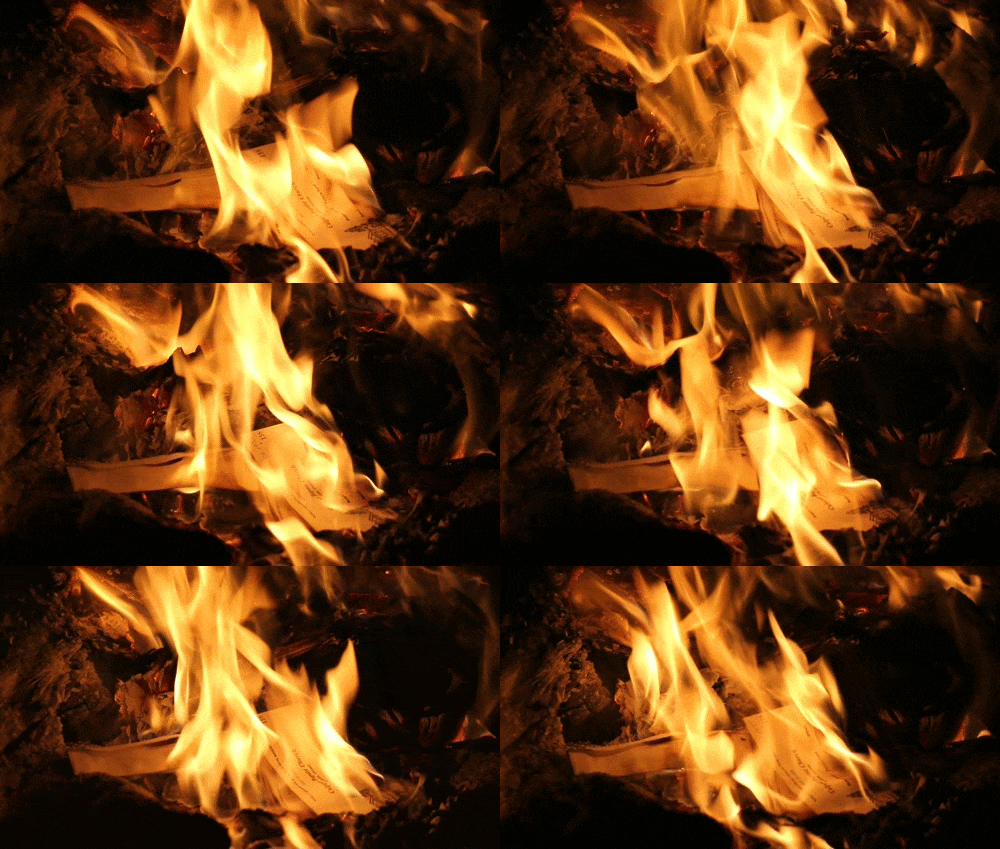
On the other hand, sometimes emotions take us to strange places as writers, even inspiring us.  I had the dubious pleasure recently of being so upset, so absolutely throw-down-and-kick-some-ass angry, that if anyone was around me at the time, I'm sure they would have spontaneous exploded, or would have gotten this kind of response: 


But in the middle of my rage, a line came to me out of the blue, and I'm sure if I hadn't been in such a terrible mood, I'd never have thought of it.  And no, I'm not going to share it with you...I'm not that generous.  But I'm saving it for when I get a chance to use it in some future work of mine.

Has this ever happened to you?  Do you write better when you feel the same as the scene you're writing?  Or can you turn it off and write whatever you need to, no matter what?  Tell me!

xoxo Sarah